Global Retailer Research for Brands: Find, Verify and Rank Buyers

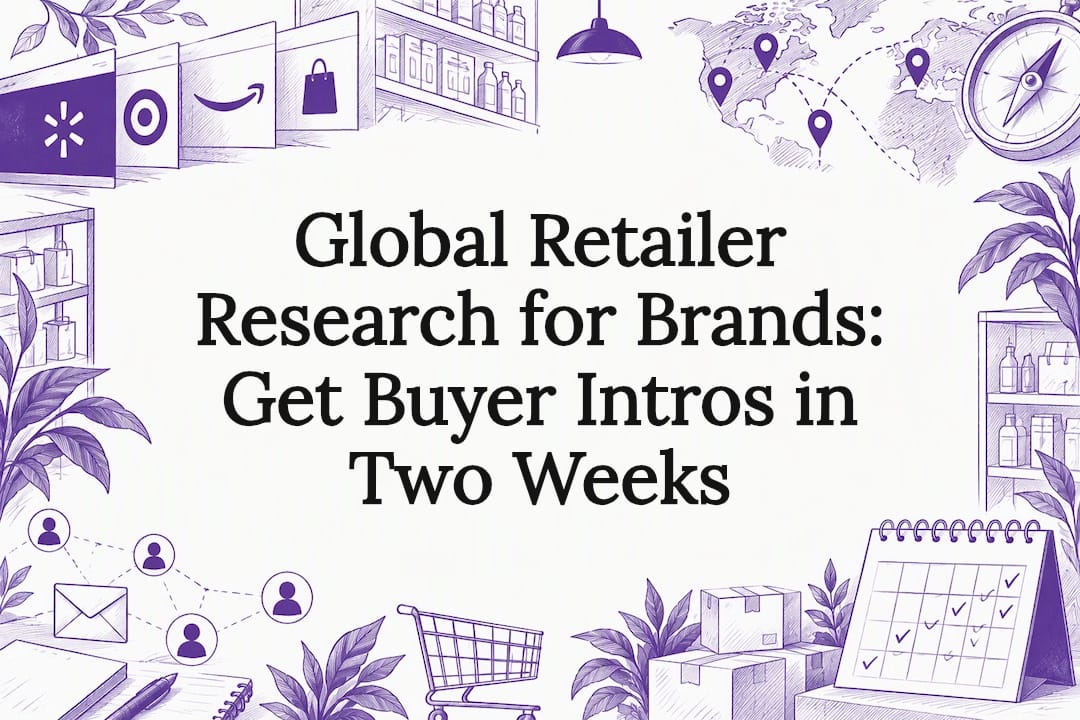
Global retailer research means identifying, verifying, and ranking specific retail buyers who fit a brand’s product, then acting on that list immediately. The output is not a report. It is a prioritized prospect and a sample-request message ready to send. Brands with a documented process behind them treat this as a repeatable operation rather than a one-time project. Kingpin has $700M+ in wholesale GMV since 2021 and 3,500+ retailers on Kingpin.
TL;DR:
Retailer research yields a prioritized list of suitable prospects by matching category, price point, and market fit, verified by direct buyer contacts.
Scoring prospects based on fit, order potential, and onboarding ease helps focus outreach on high-conversion targets.
A three-touch email sequence asking for a small, specific request like samples is the most effective outreach method.
Building a structured process with standardized templates and KPIs turns retailer research into a repeatable system.
Kingpin can handle retailer research and outreach for brands with 0% commission.
KingpinReach Relevant Retail BuyersKingpin is an AI-powered wholesale team that finds the retailers that fit your brand, reaches their buyers in their language and hands interested buyers to you.Explore Kingpin
Table of Contents
What this research covers and what it leaves out
Building a prioritized prospect list step by step
A simple rubric to qualify and rank prospects
Outreach sequencing that actually gets replies
Where to find retailer signals and buyer contacts
Turning research into a repeatable system
What brands consistently get wrong
How Kingpin handles global retailer research for you
Sources
FAQ
What this research covers and what it leaves out
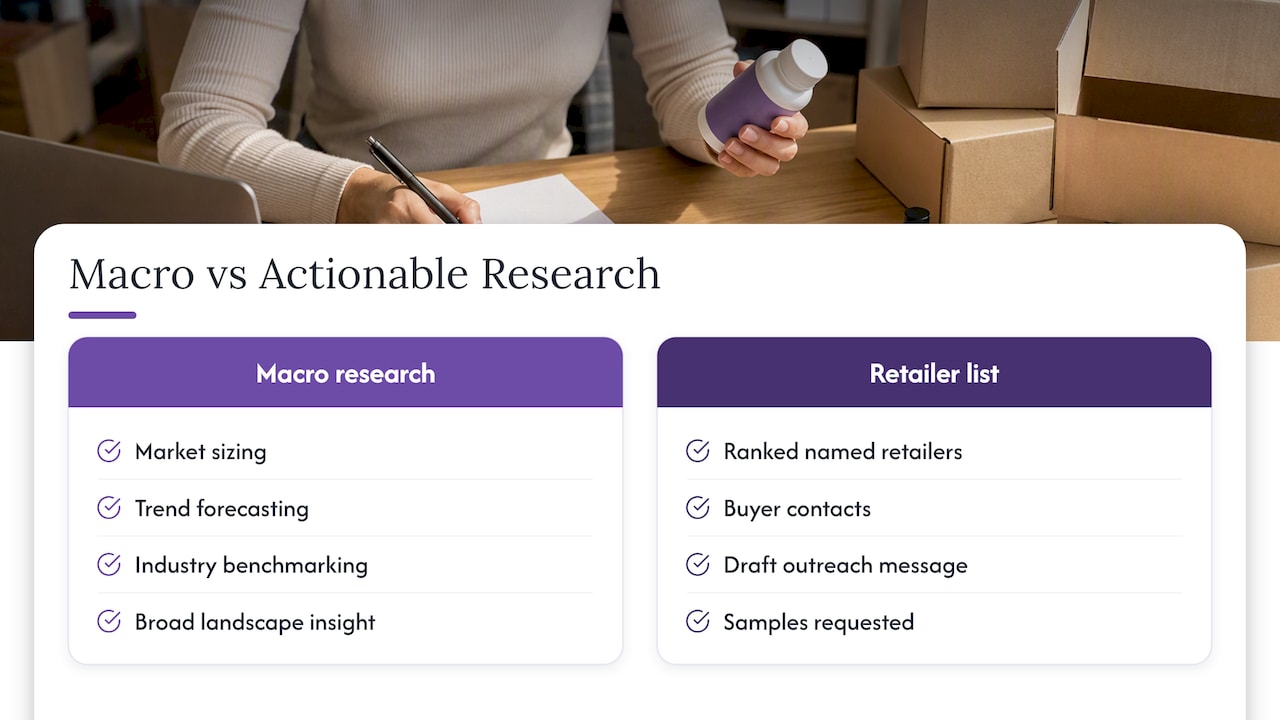
This kind of research produces a short, ranked list of named retailers and buyer contacts that match a brand’s category, price point, and market. It answers one question: who should we approach first, and why.
It is not industry-wide benchmarking, trend forecasting, or a consultancy deck full of market sizing. Brands looking for macro retail trends need a different resource entirely. Success here looks like a specific number: prospects contacted, samples requested, and meetings booked within weeks, not a broader understanding of “the retail landscape.” A brand that finishes this process should have names, contacts, and a first message drafted, not a summary of the industry.
Building a prioritized prospect list step by step
Assembling a workable list follows a consistent sequence. Skipping steps produces contacts that never respond.
Define market and fit criteria. Pick two or three target countries and set clear parameters: category, price band, minimum order quantity tolerance, and shelf format.
Source retailer candidates. Pull names from supplier intake pages, GDSN registrations, marketplace listings, and physical store audits in the target category.
Find and verify buyer contacts. Cross-reference LinkedIn titles against retailer supplier portals and company sites to confirm the right buyer, not just a generic merchandising inbox.
Record fit evidence. Log why each retailer fits: assortment overlap, price parity, adjacent brands already stocked.
Score and prioritize. Rank prospects by fit, expected order value, and how much friction onboarding will involve.
For sourcing, a few channels consistently produce usable leads:
Supplier intake pages such as Target’s supplier intake form list exactly what a retailer wants from new vendors.
Walmart’s supplier application hub explains marketplace qualification steps that reveal onboarding friction before a brand applies.
Store audits and marketplace category browsing confirm whether a retailer actually carries competing or adjacent products right now.
Once contacts are verified, everything gets logged in one place, whether that is a spreadsheet or a CRM, so the list can be revisited and expanded market by market instead of rebuilt from scratch.
A simple rubric to qualify and rank prospects
Not every retailer that fits on paper is worth the outreach effort. A basic scoring rubric keeps energy focused on prospects likely to convert.
Category and assortment fit: does the retailer already stock adjacent or comparable brands.
Price alignment: does the brand’s price point match the retailer’s typical range for the category.
Order value potential: estimate expected first order and reorder cadence based on store count or online reach.
Onboarding friction: how demanding is the supplier application, insurance requirement, or EDI setup.
Scores across these dimensions convert into simple priority bands: A for strong fit with low friction, B for good fit with moderate friction, C for speculative fits worth a light-touch attempt later. Red flags that disqualify a prospect outright include no clear buyer contact after reasonable search, a supplier portal requiring minimums far above the brand’s current capacity, or a category that is clearly closed to new vendors this cycle.
Outreach sequencing that actually gets replies
The first message should ask for one small thing, not a partnership. “Can I send samples?” outperforms a long pitch, and that pattern shows up directly in how Elavi secured a same-day reply from a Whole Foods buyer using a concise email that closed with exactly that request.
Touch one: a short email or LinkedIn message with the hook, one line on customer relevance, and the sample-request CTA.
Touch two, around day 4 to 6: a brief follow-up referencing the first message, adding one new proof point.
Touch three, around day 10 to 14: a final, low-pressure nudge asking if timing is better later in the quarter.
Pitch structure matters more than length: open with the hook, connect it to why the retailer’s own customer cares, add a credibility line, then close with the ask. Send during the middle of the week rather than Monday mornings or Friday afternoons, and keep subject lines specific rather than generic. If three touches produce no response, move on and revisit in a future season rather than escalating pressure.
Pro Tip: Lead every first message with a concrete reason the retailer’s own shopper would care, not a description of the brand itself.
Where to find retailer signals and buyer contacts
Sourcing quality contacts depends on knowing which channel fits which stage of research.
Supplier intake pages at major chains, including IKEA’s supplier guidance, lay out exact application steps and standards before a brand ever emails a buyer.
GS1’s GDSN Trade Item Implementation Guide explains how standardized GTIN and GLN identifiers sync product and location data, a backend signal that a brand is properly set up for enterprise retail integration.
LinkedIn and store audits confirm the right named buyer and verify a retailer actually carries comparable products today.
Paid retailer databases are worth the cost only once manual sourcing has proven the category and market are worth scaling.
Manual sourcing works well for a first market. Paid datasets earn their keep once a brand is expanding across several markets at once and needs volume without rebuilding the process from zero.
Turning research into a repeatable system
A prospect list only compounds in value if it lives somewhere structured. Minimum CRM fields should include source, verification status, fit score, priority band, and next follow-up date.
Standardize templates for the sample request, the follow-up, and the meeting ask, so quality doesn’t depend on who is writing that day.
Track KPIs like reply rate, sample-request conversion, and time from first touch to meeting.
Review and iterate the scoring rubric each quarter based on which A-band prospects actually converted.
This is the difference between a one-time list and a system a wholesale manager can hand to a new hire and expect the same results.
What brands consistently get wrong
Most brands ask for too much in the first message, requesting a meeting or a full line review before a buyer has any reason to trust the brand yet. That kills replies that a simple sample request would have earned.
The bigger mistake is treating research as a one-off sprint instead of a muscle. Brands that build the habit, score prospects consistently, and pace market entries instead of blitzing every region at once protect their operations and see steadier results over time.
How Kingpin handles global retailer research for you
Kingpin handles this work for consumer brands: its research agent finds the retailers that fit the brand in every market, with the reason for each one, and its sales coordinator agent writes to each buyer in their language, with the brand’s line sheet inside, all with 0% commission.
Brands with the time and a small team can run the workflow above manually and scale it market by market.
Brands that want retailer research and outreach handled without building the process themselves can hand it to Kingpin.
Kingpin has one monthly fee on every plan, set on the strategy call, and 0% commission.
Brands ready to skip the buildout can book a strategy call with Kingpin.
Sources
FAQ
What does global retailer research actually involve?
It involves identifying specific retailers that fit a brand’s category and price point, verifying the right buyer contact, and ranking prospects so outreach starts with the strongest fits. The end product is a prioritized list ready for a first message, not a market report.
How many outreach touches should a brand send before giving up?
A three-touch sequence spread over roughly 10 to 14 days is the standard practical approach, starting with a low-friction ask like a sample request. If there’s no response after three touches, it’s usually better to revisit that retailer in a future season than to keep pushing.
What should the very first outreach message ask for?
The first message should request something small and specific, such as permission to send product samples, rather than a meeting or a full partnership pitch. A concise pitch closing with a clear, low-friction ask has generated replies from major retail buyers within hours.
Is DIY retailer research or a managed service like Kingpin better?
DIY research works well for brands with time to build and run the workflow themselves on one or two markets. Brands that want the work handled without building the process can choose Kingpin, an AI-powered wholesale team with 0% commission.
Global retailer research means identifying, verifying, and ranking specific retail buyers who fit a brand’s product, then acting on that list immediately. The output is not a report. It is a prioritized prospect and a sample-request message ready to send. Brands with a documented process behind them treat this as a repeatable operation rather than a one-time project. Kingpin has $700M+ in wholesale GMV since 2021 and 3,500+ retailers on Kingpin.
TL;DR:
Retailer research yields a prioritized list of suitable prospects by matching category, price point, and market fit, verified by direct buyer contacts.
Scoring prospects based on fit, order potential, and onboarding ease helps focus outreach on high-conversion targets.
A three-touch email sequence asking for a small, specific request like samples is the most effective outreach method.
Building a structured process with standardized templates and KPIs turns retailer research into a repeatable system.
Kingpin can handle retailer research and outreach for brands with 0% commission.
KingpinReach Relevant Retail BuyersKingpin is an AI-powered wholesale team that finds the retailers that fit your brand, reaches their buyers in their language and hands interested buyers to you.Explore Kingpin
Table of Contents
What this research covers and what it leaves out
Building a prioritized prospect list step by step
A simple rubric to qualify and rank prospects
Outreach sequencing that actually gets replies
Where to find retailer signals and buyer contacts
Turning research into a repeatable system
What brands consistently get wrong
How Kingpin handles global retailer research for you
Sources
FAQ
What this research covers and what it leaves out
This kind of research produces a short, ranked list of named retailers and buyer contacts that match a brand’s category, price point, and market. It answers one question: who should we approach first, and why.
It is not industry-wide benchmarking, trend forecasting, or a consultancy deck full of market sizing. Brands looking for macro retail trends need a different resource entirely. Success here looks like a specific number: prospects contacted, samples requested, and meetings booked within weeks, not a broader understanding of “the retail landscape.” A brand that finishes this process should have names, contacts, and a first message drafted, not a summary of the industry.
Building a prioritized prospect list step by step
Assembling a workable list follows a consistent sequence. Skipping steps produces contacts that never respond.
Define market and fit criteria. Pick two or three target countries and set clear parameters: category, price band, minimum order quantity tolerance, and shelf format.
Source retailer candidates. Pull names from supplier intake pages, GDSN registrations, marketplace listings, and physical store audits in the target category.
Find and verify buyer contacts. Cross-reference LinkedIn titles against retailer supplier portals and company sites to confirm the right buyer, not just a generic merchandising inbox.
Record fit evidence. Log why each retailer fits: assortment overlap, price parity, adjacent brands already stocked.
Score and prioritize. Rank prospects by fit, expected order value, and how much friction onboarding will involve.
For sourcing, a few channels consistently produce usable leads:
Supplier intake pages such as Target’s supplier intake form list exactly what a retailer wants from new vendors.
Walmart’s supplier application hub explains marketplace qualification steps that reveal onboarding friction before a brand applies.
Store audits and marketplace category browsing confirm whether a retailer actually carries competing or adjacent products right now.
Once contacts are verified, everything gets logged in one place, whether that is a spreadsheet or a CRM, so the list can be revisited and expanded market by market instead of rebuilt from scratch.
A simple rubric to qualify and rank prospects
Not every retailer that fits on paper is worth the outreach effort. A basic scoring rubric keeps energy focused on prospects likely to convert.
Category and assortment fit: does the retailer already stock adjacent or comparable brands.
Price alignment: does the brand’s price point match the retailer’s typical range for the category.
Order value potential: estimate expected first order and reorder cadence based on store count or online reach.
Onboarding friction: how demanding is the supplier application, insurance requirement, or EDI setup.
Scores across these dimensions convert into simple priority bands: A for strong fit with low friction, B for good fit with moderate friction, C for speculative fits worth a light-touch attempt later. Red flags that disqualify a prospect outright include no clear buyer contact after reasonable search, a supplier portal requiring minimums far above the brand’s current capacity, or a category that is clearly closed to new vendors this cycle.
Outreach sequencing that actually gets replies
The first message should ask for one small thing, not a partnership. “Can I send samples?” outperforms a long pitch, and that pattern shows up directly in how Elavi secured a same-day reply from a Whole Foods buyer using a concise email that closed with exactly that request.
Touch one: a short email or LinkedIn message with the hook, one line on customer relevance, and the sample-request CTA.
Touch two, around day 4 to 6: a brief follow-up referencing the first message, adding one new proof point.
Touch three, around day 10 to 14: a final, low-pressure nudge asking if timing is better later in the quarter.
Pitch structure matters more than length: open with the hook, connect it to why the retailer’s own customer cares, add a credibility line, then close with the ask. Send during the middle of the week rather than Monday mornings or Friday afternoons, and keep subject lines specific rather than generic. If three touches produce no response, move on and revisit in a future season rather than escalating pressure.
Pro Tip: Lead every first message with a concrete reason the retailer’s own shopper would care, not a description of the brand itself.
Where to find retailer signals and buyer contacts
Sourcing quality contacts depends on knowing which channel fits which stage of research.
Supplier intake pages at major chains, including IKEA’s supplier guidance, lay out exact application steps and standards before a brand ever emails a buyer.
GS1’s GDSN Trade Item Implementation Guide explains how standardized GTIN and GLN identifiers sync product and location data, a backend signal that a brand is properly set up for enterprise retail integration.
LinkedIn and store audits confirm the right named buyer and verify a retailer actually carries comparable products today.
Paid retailer databases are worth the cost only once manual sourcing has proven the category and market are worth scaling.
Manual sourcing works well for a first market. Paid datasets earn their keep once a brand is expanding across several markets at once and needs volume without rebuilding the process from zero.
Turning research into a repeatable system
A prospect list only compounds in value if it lives somewhere structured. Minimum CRM fields should include source, verification status, fit score, priority band, and next follow-up date.
Standardize templates for the sample request, the follow-up, and the meeting ask, so quality doesn’t depend on who is writing that day.
Track KPIs like reply rate, sample-request conversion, and time from first touch to meeting.
Review and iterate the scoring rubric each quarter based on which A-band prospects actually converted.
This is the difference between a one-time list and a system a wholesale manager can hand to a new hire and expect the same results.
What brands consistently get wrong
Most brands ask for too much in the first message, requesting a meeting or a full line review before a buyer has any reason to trust the brand yet. That kills replies that a simple sample request would have earned.
The bigger mistake is treating research as a one-off sprint instead of a muscle. Brands that build the habit, score prospects consistently, and pace market entries instead of blitzing every region at once protect their operations and see steadier results over time.
How Kingpin handles global retailer research for you
Kingpin handles this work for consumer brands: its research agent finds the retailers that fit the brand in every market, with the reason for each one, and its sales coordinator agent writes to each buyer in their language, with the brand’s line sheet inside, all with 0% commission.
Brands with the time and a small team can run the workflow above manually and scale it market by market.
Brands that want retailer research and outreach handled without building the process themselves can hand it to Kingpin.
Kingpin has one monthly fee on every plan, set on the strategy call, and 0% commission.
Brands ready to skip the buildout can book a strategy call with Kingpin.
Sources
FAQ
What does global retailer research actually involve?
It involves identifying specific retailers that fit a brand’s category and price point, verifying the right buyer contact, and ranking prospects so outreach starts with the strongest fits. The end product is a prioritized list ready for a first message, not a market report.
How many outreach touches should a brand send before giving up?
A three-touch sequence spread over roughly 10 to 14 days is the standard practical approach, starting with a low-friction ask like a sample request. If there’s no response after three touches, it’s usually better to revisit that retailer in a future season than to keep pushing.
What should the very first outreach message ask for?
The first message should request something small and specific, such as permission to send product samples, rather than a meeting or a full partnership pitch. A concise pitch closing with a clear, low-friction ask has generated replies from major retail buyers within hours.
Is DIY retailer research or a managed service like Kingpin better?
DIY research works well for brands with time to build and run the workflow themselves on one or two markets. Brands that want the work handled without building the process can choose Kingpin, an AI-powered wholesale team with 0% commission.
About The Author
Ysabella Louise
Hi, I'm Ysabella, PMM at Kingpin. We believe that growing revenue shouldn't be a challenge, it should be a no-brainer. So sales teams can focus less on the struggle and more on the wins. I'm here to make sure that vision comes through in every story we tell, and to share what's working, what's changing, and what you should actually know to sell smarter.