Minimum Order Quantity: 8 Contract Clauses to Cut Cash Drag

A minimum order quantity, or MOQ, is the smallest number of units or the smallest dollar value a supplier will accept on a single order. The immediate test of whether an MOQ works for your business is simple: divide the MOQ by your average monthly sales to get months of stock. If that number sits comfortably within your planning horizon, the MOQ is workable. If it stretches far beyond it, the next sections show how to calculate the real cost and what to do about it.
TL;DR:
An MOQ can be driven by fixed costs like tooling, setup, or packaging, which dictate the minimum volume needed for a profitable production run.
When the MOQ exceeds your EOQ, it can lead to excess inventory, higher carrying costs, and cash flow strain, especially for fast-moving products.
To assess if an MOQ is workable, calculate months of stock it represents and compare it to your demand and inventory tolerance levels before committing.
Negotiating lower MOQs often involves risk reduction strategies such as higher deposits, shared components, or flexible delivery schedules.
Proper planning and grouping SKUs or extending demand periods help manage MOQ constraints across multiple reorder cycles and growth stages.
KingpinFind the Right Retailers for Your BrandKingpin connects consumer brands with relevant global retailers, helping build buyer relationships while keeping retail ownership in your hands.Explore Kingpin
Table of Contents
1. What MOQ means and the common types suppliers use
2. Why suppliers set MOQs: the supplier economics behind minimums
3. MOQ vs EOQ and the inventory consequences when EOQ falls short
4. How to calculate whether an MOQ is workable
5. Negotiation tactics and commercial workarounds to reduce MOQ risk
6. Planning and inventory strategies to operate with MOQs
7. Benefits and trade-offs from the supplier and buyer perspectives
8. Contract and PO checklist to include when accepting an MOQ
9. Impact of MOQ on cash flow and working capital
10. Industry-specific MOQ variations and standards
11. Strategies for start-ups and small businesses to manage MOQs
12. Kingpin perspective: building a broader retailer base
13. Optional help: Kingpin as an AI-powered wholesale team
Sources
FAQ
1. What MOQ means and the common types suppliers use
Suppliers structure minimums in two basic ways. A unit-based MOQ sets a fixed quantity, such as 500 pieces per style. A value-based MOQ sets a dollar floor instead, such as $2,000 per order, which lets the buyer choose the product mix as long as the total clears the threshold. According to NetSuite, an MOQ is the lowest number of units or minimum total dollar value a supplier requires for an order to be accepted, and both formats show up constantly in wholesale and manufacturing contracts.
MOQs also vary in complexity. A simple MOQ applies one number to the whole order. A complex MOQ applies rules at the SKU or variant level, so a supplier might require 300 units total but no fewer than 50 units per color. Component-driven MOQs go a step further: the constraint traces back to a single input, like a printed carton or a specific fabric roll, rather than the finished product itself.
Buyers also run into order multiples, case packs, and pallet minimums layered on top of the base MOQ:
Order multiples require quantities in fixed increments, such as orders of 12, 24, or 36 units.
Case packs bundle a set number of units per carton, which becomes the practical minimum even if the stated MOQ is lower.
Pallet minimums apply at the freight level, pushing buyers toward full or half pallets to keep shipping costs reasonable.
Packaging minimums can force a minimum print run on labels or boxes even when the product MOQ itself is smaller.
Reading a quote carefully means asking which of these layers actually applies, since a supplier’s “MOQ” figure often hides a second, tighter constraint underneath it.
2. Why suppliers set MOQs: the supplier economics behind minimums
An MOQ is rarely arbitrary. It is a supplier’s way of making sure a production run covers its fixed costs before a single unit turns a profit. Understanding those costs gives a buyer something concrete to negotiate against, rather than just asking a supplier to “go lower.”
Four cost drivers tend to set the floor:
Tooling and setup costs: molds, dyes, and machine calibration are paid once per run regardless of volume, so a small order still absorbs the same fixed expense.
Upstream vendor minimums: a supplier’s own packaging or component vendors often carry their own MOQs, which become binding constraints passed down to the buyer.
Logistics and pallet efficiency: shipping a partial pallet or a less-than-container load costs nearly as much as shipping a full one, so suppliers set minimums that align with efficient freight units.
Labor and changeover time: switching a production line between products or colors takes time that a short run cannot amortize as cheaply as a long one.
Put together, these costs establish a break-even point: the volume at which revenue from the order covers the fixed cost of running it. The NetSuite framing of MOQ makes this explicit: suppliers set minimums to ensure fixed costs per production run are covered, not to be difficult.
This is also why the Minimum Order Quantity Playbook points out that the highest-binding cost, often a packaging component or a dye lot, tends to set the finished-product MOQ rather than the core manufacturing process. Identify that single binding constraint and you know exactly which lever to pull in a negotiation.
3. MOQ vs EOQ and the inventory consequences when EOQ falls short
Economic order quantity, or EOQ, is the internal formula that tells a buyer how much to order minimizing the combined cost of ordering and holding inventory. It balances ordering costs against carrying costs to find the mathematically efficient order size for your own demand, independent of what a supplier requires.
The trouble starts when a supplier’s MOQ is higher than your EOQ. NetSuite identifies this gap as a primary driver of excess inventory for ecommerce businesses: you are forced to buy more than the efficient quantity, which pushes carrying costs above what your own demand curve would otherwise justify.
Three numbers make the gap concrete:
Months of stock = MOQ ÷ average monthly sales.
Annual carrying cost = unit cost × holding cost percentage × months of stock ÷ 12.
Incremental carrying cost of the MOQ = carrying cost at MOQ minus carrying cost at EOQ.
One practitioner benchmark puts annual holding cost at 20% to 30% of inventory value, which means a supplier minimum that forces double your efficient order size can meaningfully erode margin before a single unit sells.
The practical outcomes of an EOQ-MOQ gap are familiar to anyone who has run inventory: excess stock sitting in a warehouse, slow-moving SKUs edging toward dead stock, and cash tied up in product that will not turn for months. None of that shows up on a purchase order, which is exactly why it needs to be calculated before the order is placed, not after.
4. How to calculate whether an MOQ is workable
Running the numbers before you commit takes a few minutes and prevents most of the inventory headaches that come from accepting an MOQ at face value.
Determine average monthly demand and safety stock. Pull trailing sales data and add a buffer for demand variability so the calculation reflects real conditions, not a best case.
Calculate months of cover. Divide the MOQ by average monthly demand. An MOQ of 1,200 units against monthly demand of 200 means six months of cover.
Compute annual holding cost. Multiply unit cost by your holding cost percentage, then by months of cover divided by 12, to see the dollar cost of carrying that stock.
Apply the supplier break-even heuristic. A simplified rule some practitioners use is MOQ ≈ fixed cost per run ÷ profit per unit, according to the OmniOrders breakdown of the formula. Say a production run costs $3,000 in fixed setup and each unit earns $6 in profit: the supplier’s implied minimum lands near 500 units, a useful check against the number they actually quote.
Apply a decision rule. Compare months of cover against your business model’s tolerance: a fast-moving consumer product might tolerate two to three months, while a durable or seasonal good can often absorb more.
Pro Tip: Run the months-of-cover math before you ask for a quote revision. Knowing your own threshold gives you a number to negotiate toward instead of a vague request for “lower.”
If months of cover clears your threshold, accept the MOQ and move on. If it does not, the next section covers how to bring it down without simply asking a supplier to shrink the number.
5. Negotiation tactics and commercial workarounds to reduce MOQ risk
Most MOQs are negotiable once you understand what the supplier is actually protecting against. Shopify’s guidance frames this clearly: suppliers will often lower a first-order MOQ if the buyer removes the supplier’s risk, so the negotiation works best when it is framed as risk reduction rather than a request to change a number.
A handful of tactics show up repeatedly in practitioner guidance:
Offer a higher deposit or accept a higher per-unit price on the first order in exchange for a smaller quantity.
Propose a blanket purchase order with a scheduled release plan, which gives the supplier volume certainty while letting you take smaller physical deliveries.
Combine SKUs into a single production run where the underlying materials allow it, spreading the fixed cost across more of your catalog.
Choose stock packaging or standard colors instead of custom runs, since custom printing or dyeing is frequently the component driving the MOQ in the first place.
Offer to pay for or consign the bottleneck component directly, whether that is a printed carton, a specialized part, or a dye lot.
That last point matters enough to ask directly: which single component is setting this MOQ? The Minimum Order Quantity Playbook notes that a supplier’s visible MOQ often traces to the most restrictive input, and paying for or consigning that specific component can bring the finished-product minimum down without touching the supplier’s core manufacturing economics. Procurement teams looking for structured scripts to run these conversations can also draw on frameworks like the negotiation tactics used by account executives holding price under time pressure, which apply the same risk-transfer logic to a different sales context.
Pro Tip: Ask “which component drives this minimum” before you ask for a lower number. Suppliers answer that question honestly far more often than they negotiate blind.
6. Planning and inventory strategies to operate with MOQs
Negotiation solves individual orders. Planning solves the recurring stress of hitting MOQs every single reorder cycle. The shift is to treat the MOQ as a known upstream constraint and design your buy cadence around it, rather than discovering it fresh every time a purchase order goes out.
A few practices make this workable at scale:
Group SKUs by supplier and timing so multiple products cross the MOQ threshold together instead of each style fighting the minimum alone.
Aggregate demand across a longer window when a single month falls short, ordering less often but in quantities that make sense against both MOQ and EOQ.
Use blanket purchase orders with release schedules to lock in pricing and supplier commitment while staging deliveries against actual demand.
Track MOQ months, inventory turnover, and cash tied up as standing KPIs, not one-off calculations run only when a new supplier quote arrives.
Inventory planning resources focused on ecommerce forecast aggregation make the same point: the right response to an MOQ is not always negotiation. Sometimes it is redesigning the buy calendar so supplier minimums are met through aggregation rather than single-SKU overstock. On enforceability, the Minimum Order Quantity Playbook is direct: a blanket purchase order needs signed quantity commitments and explicit schedule and remedy terms, or it carries little weight when a supplier’s own conditions change mid-cycle.
7. Benefits and trade-offs from the supplier and buyer perspectives
MOQs exist because they work for someone, usually the supplier, and the trade-off only makes sense once both sides of the ledger are visible.
On the supplier side, minimums bring production predictability and let fixed costs spread across a large enough run to lower the unit cost for everyone. On the buyer side, a higher MOQ often comes bundled with a volume discount and firmer supplier commitment to future capacity, which matters when a product is likely to grow.
The downside sits squarely with the buyer:
Carrying cost rises whenever the MOQ pushes an order size above the buyer’s own EOQ.
Obsolescence risk grows for seasonal or fast-changing products ordered in bulk.
Cash flow tightens as capital sits in inventory instead of funding the next order or another part of the business.
A high MOQ still makes strategic sense when the unit-cost discount is large, demand is stable and growing, or the product has a long shelf life that removes the obsolescence risk entirely. Academic research on supply-chain structure adds a market-level angle: MOQ requirements can support single-sourcing arrangements that raise a retailer’s profitability precisely because they reduce downstream competition, a reminder that the supplier’s incentive to hold a firm MOQ often runs deeper than production cost alone.
8. Contract and PO checklist to include when accepting an MOQ
A quoted MOQ is only half the picture until it is written into a contract with enough precision to prevent disputes later. Before signing, confirm these terms appear in writing:
MOQ definition: whether the minimum applies per unit, per SKU, per case pack, or as a total dollar value.
Order multiples: the fixed increments above the MOQ that future orders must follow.
Delivery terms: whether partial shipments or scheduled releases are permitted, and which Incoterms® govern the transfer of risk and cost.
Pricing schedule: unit price at each volume tier, plus any fee for changing or canceling an order after confirmation.
Packaging ownership: who owns custom packaging or tooling if the relationship ends.
Leftover inventory terms: what happens to unsold component stock, especially for consigned materials.
Quality acceptance criteria: the standard against which delivered goods are inspected and accepted.
Dispute remedies: the process and recourse if quantity, quality, or timing terms are not met.
Getting these eight items in writing turns a verbal understanding into an enforceable agreement, which matters most exactly when a relationship hits its first disagreement.
9. Impact of MOQ on cash flow and working capital
An MOQ does not just occupy warehouse shelves, it locks up capital that could otherwise fund payroll, marketing, or the next product line. Every dollar spent to meet a minimum above your actual near-term need is a dollar removed from working capital until that inventory sells through.
The effect compounds for growing brands. A young company chasing a new retail account often has to place its largest order at the exact moment cash is tightest, since MOQ requirements do not scale down for a smaller balance sheet. That mismatch between order size and available capital is one of the most common reasons early wholesale relationships stall before the second order ever ships.
Value-based MOQs add a subtler pressure: hitting a dollar minimum by adding units of a slower-moving SKU means capital sits against a product that may not turn as quickly as the core line, quietly dragging down overall inventory turnover.
The practical fix is to treat the carrying cost calculation from earlier sections as a cash flow forecast, not just an inventory metric. Months of stock translates directly into months that capital stays tied up, and running that number before committing to an order gives finance teams a clear view of how much runway the purchase actually consumes.
10. Industry-specific MOQ variations and standards
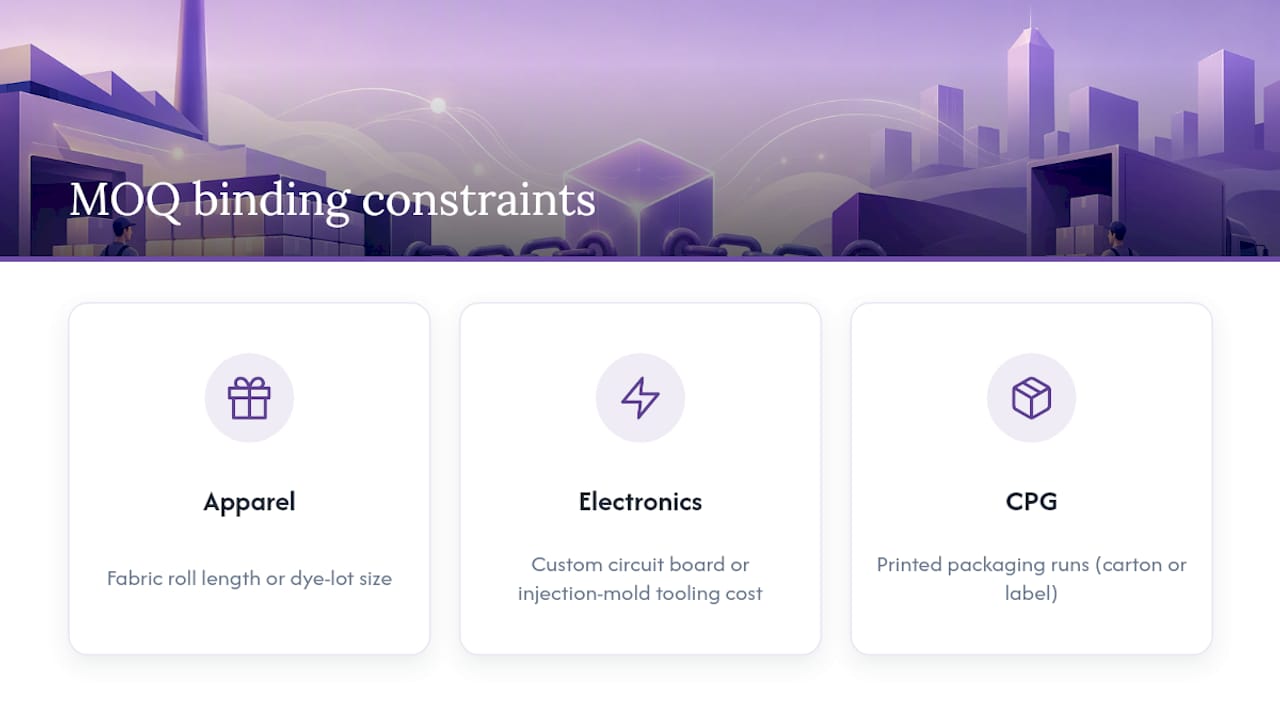
MOQs look different depending on what is being manufactured, since the cost drivers behind them vary by industry. Apparel and textile MOQs are often set by fabric roll length or dye lot size, which is why changing a color can shift the minimum even when the garment itself stays the same. Electronics and hardware MOQs frequently trace back to a specific component, such as a custom circuit board or injection-molded part, where the tooling cost dominates the calculation.
Consumer packaged goods often carry value-based MOQs tied to packaging print runs, since a printed carton or label is usually the most restrictive input in the chain. Specialty categories carry their own quirks: a wholesale guide for percussion suppliers illustrates how a niche hardware category can face MOQs driven almost entirely by a single specialized component, echoing the same pattern seen across other manufactured goods.
There is no universal MOQ standard across industries, and the number a buyer sees on one supplier’s quote says little about what is reasonable in a different category. The consistent thread is that the binding constraint, whether fabric, packaging, or a single part, is worth identifying before comparing MOQs across suppliers or industries.
11. Strategies for start-ups and small businesses to manage MOQs
A small or early-stage business feels MOQ pressure more acutely than an established one, since a large first order competes directly with limited cash and an unproven sales history. A few approaches consistently help.
Start by testing demand with a smaller, higher-priced first run when a supplier will accept it, even if the unit economics are less favorable than at full volume. The goal at this stage is validating sell-through, not maximizing margin.
Where a single supplier’s MOQ is out of reach, look for co-manufacturers or smaller-batch producers who serve early-stage brands specifically, even at a higher per-unit cost. That premium often costs less than the carrying cost of an oversized order sitting unsold.
Stock packaging and standard colors avoid the custom-run minimums that trip up many first orders, and combining multiple product variants into a single production run can spread a fixed cost across a wider catalog. Finally, treat every early order as a data point: the months-of-cover calculation from earlier sections applies just as directly to a startup’s first 500 units as it does to an established brand’s tenth reorder.
12. Kingpin perspective: building a broader retailer base
The MOQ conversation usually stops at the factory, but the same logic applies on the retail side. Relying on one large retail commitment can magnify the MOQ risks covered above. Kingpin’s research agent finds the retailers that fit your brand in every market, and its sales coordinator agent reaches their buyers in their language. Interested buyers are handed to your brand, and every buyer relationship stays with your brand.
13. Optional help: Kingpin as an AI-powered wholesale team
Working through supplier MOQs is only half the equation. The other half is building a wider base of retailer relationships, and that is where an AI-powered wholesale team can help.
Kingpin finds the retailers that fit your brand, reaches their buyers in their language and hands interested buyers to you. This gives your brand a broader set of buyer relationships to draw on when making its own MOQ decisions, rather than relying on one account’s forecast.
Buyer discovery by category and market, with the reason each retailer fits your brand.
Order processing for orders that arrive by Excel, WhatsApp or PDF, which are keyed in and confirmed.
Zero commission, with the brand keeping full ownership of every buyer relationship.
A brand juggling supplier negotiations and its own retail growth at the same time often benefits from handing buyer outreach to a dedicated partner. Explore Kingpin to see how its wholesale team can support your retail growth.
Sources
The figures and formulas in this guide draw on a small set of practitioner and academic sources worth reading directly.
FAQ
What is the minimum order quantity?
A minimum order quantity is the smallest number of units or dollar value a supplier will accept on a single order, set to cover the fixed costs of running a production batch. It can apply per unit, per SKU, or as a total order value, as explained by NetSuite.
What is EOQ and MOQ?
EOQ, or economic order quantity, is the order size that minimizes a buyer’s own combined ordering and holding costs, calculated independently of any supplier requirement. MOQ is the supplier’s minimum acceptable order, and when EOQ falls below MOQ, buyers end up holding more inventory than their own demand curve would otherwise justify, according to NetSuite.
What is the meaning of minimum quantity?
Minimum quantity refers to the smallest amount of product a buyer must purchase in a single transaction, whether that is expressed in units, cases, pallets, or a dollar total. It functions as a floor a supplier sets to make a given production run or shipment financially worthwhile.
How do you calculate a minimum reorder quantity?
Divide the supplier’s MOQ by your average monthly demand to get months of cover, then multiply your unit cost by your holding cost percentage and by months of cover divided by 12 to estimate the carrying cost of that order. A rough supplier-side check, MOQ ≈ fixed cost per run ÷ profit per unit, can help explain why a given minimum was set, as outlined by OmniOrders.
A minimum order quantity, or MOQ, is the smallest number of units or the smallest dollar value a supplier will accept on a single order. The immediate test of whether an MOQ works for your business is simple: divide the MOQ by your average monthly sales to get months of stock. If that number sits comfortably within your planning horizon, the MOQ is workable. If it stretches far beyond it, the next sections show how to calculate the real cost and what to do about it.
TL;DR:
An MOQ can be driven by fixed costs like tooling, setup, or packaging, which dictate the minimum volume needed for a profitable production run.
When the MOQ exceeds your EOQ, it can lead to excess inventory, higher carrying costs, and cash flow strain, especially for fast-moving products.
To assess if an MOQ is workable, calculate months of stock it represents and compare it to your demand and inventory tolerance levels before committing.
Negotiating lower MOQs often involves risk reduction strategies such as higher deposits, shared components, or flexible delivery schedules.
Proper planning and grouping SKUs or extending demand periods help manage MOQ constraints across multiple reorder cycles and growth stages.
KingpinFind the Right Retailers for Your BrandKingpin connects consumer brands with relevant global retailers, helping build buyer relationships while keeping retail ownership in your hands.Explore Kingpin
Table of Contents
1. What MOQ means and the common types suppliers use
2. Why suppliers set MOQs: the supplier economics behind minimums
3. MOQ vs EOQ and the inventory consequences when EOQ falls short
4. How to calculate whether an MOQ is workable
5. Negotiation tactics and commercial workarounds to reduce MOQ risk
6. Planning and inventory strategies to operate with MOQs
7. Benefits and trade-offs from the supplier and buyer perspectives
8. Contract and PO checklist to include when accepting an MOQ
9. Impact of MOQ on cash flow and working capital
10. Industry-specific MOQ variations and standards
11. Strategies for start-ups and small businesses to manage MOQs
12. Kingpin perspective: building a broader retailer base
13. Optional help: Kingpin as an AI-powered wholesale team
Sources
FAQ
1. What MOQ means and the common types suppliers use
Suppliers structure minimums in two basic ways. A unit-based MOQ sets a fixed quantity, such as 500 pieces per style. A value-based MOQ sets a dollar floor instead, such as $2,000 per order, which lets the buyer choose the product mix as long as the total clears the threshold. According to NetSuite, an MOQ is the lowest number of units or minimum total dollar value a supplier requires for an order to be accepted, and both formats show up constantly in wholesale and manufacturing contracts.
MOQs also vary in complexity. A simple MOQ applies one number to the whole order. A complex MOQ applies rules at the SKU or variant level, so a supplier might require 300 units total but no fewer than 50 units per color. Component-driven MOQs go a step further: the constraint traces back to a single input, like a printed carton or a specific fabric roll, rather than the finished product itself.
Buyers also run into order multiples, case packs, and pallet minimums layered on top of the base MOQ:
Order multiples require quantities in fixed increments, such as orders of 12, 24, or 36 units.
Case packs bundle a set number of units per carton, which becomes the practical minimum even if the stated MOQ is lower.
Pallet minimums apply at the freight level, pushing buyers toward full or half pallets to keep shipping costs reasonable.
Packaging minimums can force a minimum print run on labels or boxes even when the product MOQ itself is smaller.
Reading a quote carefully means asking which of these layers actually applies, since a supplier’s “MOQ” figure often hides a second, tighter constraint underneath it.
2. Why suppliers set MOQs: the supplier economics behind minimums
An MOQ is rarely arbitrary. It is a supplier’s way of making sure a production run covers its fixed costs before a single unit turns a profit. Understanding those costs gives a buyer something concrete to negotiate against, rather than just asking a supplier to “go lower.”
Four cost drivers tend to set the floor:
Tooling and setup costs: molds, dyes, and machine calibration are paid once per run regardless of volume, so a small order still absorbs the same fixed expense.
Upstream vendor minimums: a supplier’s own packaging or component vendors often carry their own MOQs, which become binding constraints passed down to the buyer.
Logistics and pallet efficiency: shipping a partial pallet or a less-than-container load costs nearly as much as shipping a full one, so suppliers set minimums that align with efficient freight units.
Labor and changeover time: switching a production line between products or colors takes time that a short run cannot amortize as cheaply as a long one.
Put together, these costs establish a break-even point: the volume at which revenue from the order covers the fixed cost of running it. The NetSuite framing of MOQ makes this explicit: suppliers set minimums to ensure fixed costs per production run are covered, not to be difficult.
This is also why the Minimum Order Quantity Playbook points out that the highest-binding cost, often a packaging component or a dye lot, tends to set the finished-product MOQ rather than the core manufacturing process. Identify that single binding constraint and you know exactly which lever to pull in a negotiation.
3. MOQ vs EOQ and the inventory consequences when EOQ falls short
Economic order quantity, or EOQ, is the internal formula that tells a buyer how much to order minimizing the combined cost of ordering and holding inventory. It balances ordering costs against carrying costs to find the mathematically efficient order size for your own demand, independent of what a supplier requires.
The trouble starts when a supplier’s MOQ is higher than your EOQ. NetSuite identifies this gap as a primary driver of excess inventory for ecommerce businesses: you are forced to buy more than the efficient quantity, which pushes carrying costs above what your own demand curve would otherwise justify.
Three numbers make the gap concrete:
Months of stock = MOQ ÷ average monthly sales.
Annual carrying cost = unit cost × holding cost percentage × months of stock ÷ 12.
Incremental carrying cost of the MOQ = carrying cost at MOQ minus carrying cost at EOQ.
One practitioner benchmark puts annual holding cost at 20% to 30% of inventory value, which means a supplier minimum that forces double your efficient order size can meaningfully erode margin before a single unit sells.
The practical outcomes of an EOQ-MOQ gap are familiar to anyone who has run inventory: excess stock sitting in a warehouse, slow-moving SKUs edging toward dead stock, and cash tied up in product that will not turn for months. None of that shows up on a purchase order, which is exactly why it needs to be calculated before the order is placed, not after.
4. How to calculate whether an MOQ is workable
Running the numbers before you commit takes a few minutes and prevents most of the inventory headaches that come from accepting an MOQ at face value.
Determine average monthly demand and safety stock. Pull trailing sales data and add a buffer for demand variability so the calculation reflects real conditions, not a best case.
Calculate months of cover. Divide the MOQ by average monthly demand. An MOQ of 1,200 units against monthly demand of 200 means six months of cover.
Compute annual holding cost. Multiply unit cost by your holding cost percentage, then by months of cover divided by 12, to see the dollar cost of carrying that stock.
Apply the supplier break-even heuristic. A simplified rule some practitioners use is MOQ ≈ fixed cost per run ÷ profit per unit, according to the OmniOrders breakdown of the formula. Say a production run costs $3,000 in fixed setup and each unit earns $6 in profit: the supplier’s implied minimum lands near 500 units, a useful check against the number they actually quote.
Apply a decision rule. Compare months of cover against your business model’s tolerance: a fast-moving consumer product might tolerate two to three months, while a durable or seasonal good can often absorb more.
Pro Tip: Run the months-of-cover math before you ask for a quote revision. Knowing your own threshold gives you a number to negotiate toward instead of a vague request for “lower.”
If months of cover clears your threshold, accept the MOQ and move on. If it does not, the next section covers how to bring it down without simply asking a supplier to shrink the number.
5. Negotiation tactics and commercial workarounds to reduce MOQ risk
Most MOQs are negotiable once you understand what the supplier is actually protecting against. Shopify’s guidance frames this clearly: suppliers will often lower a first-order MOQ if the buyer removes the supplier’s risk, so the negotiation works best when it is framed as risk reduction rather than a request to change a number.
A handful of tactics show up repeatedly in practitioner guidance:
Offer a higher deposit or accept a higher per-unit price on the first order in exchange for a smaller quantity.
Propose a blanket purchase order with a scheduled release plan, which gives the supplier volume certainty while letting you take smaller physical deliveries.
Combine SKUs into a single production run where the underlying materials allow it, spreading the fixed cost across more of your catalog.
Choose stock packaging or standard colors instead of custom runs, since custom printing or dyeing is frequently the component driving the MOQ in the first place.
Offer to pay for or consign the bottleneck component directly, whether that is a printed carton, a specialized part, or a dye lot.
That last point matters enough to ask directly: which single component is setting this MOQ? The Minimum Order Quantity Playbook notes that a supplier’s visible MOQ often traces to the most restrictive input, and paying for or consigning that specific component can bring the finished-product minimum down without touching the supplier’s core manufacturing economics. Procurement teams looking for structured scripts to run these conversations can also draw on frameworks like the negotiation tactics used by account executives holding price under time pressure, which apply the same risk-transfer logic to a different sales context.
Pro Tip: Ask “which component drives this minimum” before you ask for a lower number. Suppliers answer that question honestly far more often than they negotiate blind.
6. Planning and inventory strategies to operate with MOQs
Negotiation solves individual orders. Planning solves the recurring stress of hitting MOQs every single reorder cycle. The shift is to treat the MOQ as a known upstream constraint and design your buy cadence around it, rather than discovering it fresh every time a purchase order goes out.
A few practices make this workable at scale:
Group SKUs by supplier and timing so multiple products cross the MOQ threshold together instead of each style fighting the minimum alone.
Aggregate demand across a longer window when a single month falls short, ordering less often but in quantities that make sense against both MOQ and EOQ.
Use blanket purchase orders with release schedules to lock in pricing and supplier commitment while staging deliveries against actual demand.
Track MOQ months, inventory turnover, and cash tied up as standing KPIs, not one-off calculations run only when a new supplier quote arrives.
Inventory planning resources focused on ecommerce forecast aggregation make the same point: the right response to an MOQ is not always negotiation. Sometimes it is redesigning the buy calendar so supplier minimums are met through aggregation rather than single-SKU overstock. On enforceability, the Minimum Order Quantity Playbook is direct: a blanket purchase order needs signed quantity commitments and explicit schedule and remedy terms, or it carries little weight when a supplier’s own conditions change mid-cycle.
7. Benefits and trade-offs from the supplier and buyer perspectives
MOQs exist because they work for someone, usually the supplier, and the trade-off only makes sense once both sides of the ledger are visible.
On the supplier side, minimums bring production predictability and let fixed costs spread across a large enough run to lower the unit cost for everyone. On the buyer side, a higher MOQ often comes bundled with a volume discount and firmer supplier commitment to future capacity, which matters when a product is likely to grow.
The downside sits squarely with the buyer:
Carrying cost rises whenever the MOQ pushes an order size above the buyer’s own EOQ.
Obsolescence risk grows for seasonal or fast-changing products ordered in bulk.
Cash flow tightens as capital sits in inventory instead of funding the next order or another part of the business.
A high MOQ still makes strategic sense when the unit-cost discount is large, demand is stable and growing, or the product has a long shelf life that removes the obsolescence risk entirely. Academic research on supply-chain structure adds a market-level angle: MOQ requirements can support single-sourcing arrangements that raise a retailer’s profitability precisely because they reduce downstream competition, a reminder that the supplier’s incentive to hold a firm MOQ often runs deeper than production cost alone.
8. Contract and PO checklist to include when accepting an MOQ
A quoted MOQ is only half the picture until it is written into a contract with enough precision to prevent disputes later. Before signing, confirm these terms appear in writing:
MOQ definition: whether the minimum applies per unit, per SKU, per case pack, or as a total dollar value.
Order multiples: the fixed increments above the MOQ that future orders must follow.
Delivery terms: whether partial shipments or scheduled releases are permitted, and which Incoterms® govern the transfer of risk and cost.
Pricing schedule: unit price at each volume tier, plus any fee for changing or canceling an order after confirmation.
Packaging ownership: who owns custom packaging or tooling if the relationship ends.
Leftover inventory terms: what happens to unsold component stock, especially for consigned materials.
Quality acceptance criteria: the standard against which delivered goods are inspected and accepted.
Dispute remedies: the process and recourse if quantity, quality, or timing terms are not met.
Getting these eight items in writing turns a verbal understanding into an enforceable agreement, which matters most exactly when a relationship hits its first disagreement.
9. Impact of MOQ on cash flow and working capital
An MOQ does not just occupy warehouse shelves, it locks up capital that could otherwise fund payroll, marketing, or the next product line. Every dollar spent to meet a minimum above your actual near-term need is a dollar removed from working capital until that inventory sells through.
The effect compounds for growing brands. A young company chasing a new retail account often has to place its largest order at the exact moment cash is tightest, since MOQ requirements do not scale down for a smaller balance sheet. That mismatch between order size and available capital is one of the most common reasons early wholesale relationships stall before the second order ever ships.
Value-based MOQs add a subtler pressure: hitting a dollar minimum by adding units of a slower-moving SKU means capital sits against a product that may not turn as quickly as the core line, quietly dragging down overall inventory turnover.
The practical fix is to treat the carrying cost calculation from earlier sections as a cash flow forecast, not just an inventory metric. Months of stock translates directly into months that capital stays tied up, and running that number before committing to an order gives finance teams a clear view of how much runway the purchase actually consumes.
10. Industry-specific MOQ variations and standards
MOQs look different depending on what is being manufactured, since the cost drivers behind them vary by industry. Apparel and textile MOQs are often set by fabric roll length or dye lot size, which is why changing a color can shift the minimum even when the garment itself stays the same. Electronics and hardware MOQs frequently trace back to a specific component, such as a custom circuit board or injection-molded part, where the tooling cost dominates the calculation.
Consumer packaged goods often carry value-based MOQs tied to packaging print runs, since a printed carton or label is usually the most restrictive input in the chain. Specialty categories carry their own quirks: a wholesale guide for percussion suppliers illustrates how a niche hardware category can face MOQs driven almost entirely by a single specialized component, echoing the same pattern seen across other manufactured goods.
There is no universal MOQ standard across industries, and the number a buyer sees on one supplier’s quote says little about what is reasonable in a different category. The consistent thread is that the binding constraint, whether fabric, packaging, or a single part, is worth identifying before comparing MOQs across suppliers or industries.
11. Strategies for start-ups and small businesses to manage MOQs
A small or early-stage business feels MOQ pressure more acutely than an established one, since a large first order competes directly with limited cash and an unproven sales history. A few approaches consistently help.
Start by testing demand with a smaller, higher-priced first run when a supplier will accept it, even if the unit economics are less favorable than at full volume. The goal at this stage is validating sell-through, not maximizing margin.
Where a single supplier’s MOQ is out of reach, look for co-manufacturers or smaller-batch producers who serve early-stage brands specifically, even at a higher per-unit cost. That premium often costs less than the carrying cost of an oversized order sitting unsold.
Stock packaging and standard colors avoid the custom-run minimums that trip up many first orders, and combining multiple product variants into a single production run can spread a fixed cost across a wider catalog. Finally, treat every early order as a data point: the months-of-cover calculation from earlier sections applies just as directly to a startup’s first 500 units as it does to an established brand’s tenth reorder.
12. Kingpin perspective: building a broader retailer base
The MOQ conversation usually stops at the factory, but the same logic applies on the retail side. Relying on one large retail commitment can magnify the MOQ risks covered above. Kingpin’s research agent finds the retailers that fit your brand in every market, and its sales coordinator agent reaches their buyers in their language. Interested buyers are handed to your brand, and every buyer relationship stays with your brand.
13. Optional help: Kingpin as an AI-powered wholesale team
Working through supplier MOQs is only half the equation. The other half is building a wider base of retailer relationships, and that is where an AI-powered wholesale team can help.
Kingpin finds the retailers that fit your brand, reaches their buyers in their language and hands interested buyers to you. This gives your brand a broader set of buyer relationships to draw on when making its own MOQ decisions, rather than relying on one account’s forecast.
Buyer discovery by category and market, with the reason each retailer fits your brand.
Order processing for orders that arrive by Excel, WhatsApp or PDF, which are keyed in and confirmed.
Zero commission, with the brand keeping full ownership of every buyer relationship.
A brand juggling supplier negotiations and its own retail growth at the same time often benefits from handing buyer outreach to a dedicated partner. Explore Kingpin to see how its wholesale team can support your retail growth.
Sources
The figures and formulas in this guide draw on a small set of practitioner and academic sources worth reading directly.
FAQ
What is the minimum order quantity?
A minimum order quantity is the smallest number of units or dollar value a supplier will accept on a single order, set to cover the fixed costs of running a production batch. It can apply per unit, per SKU, or as a total order value, as explained by NetSuite.
What is EOQ and MOQ?
EOQ, or economic order quantity, is the order size that minimizes a buyer’s own combined ordering and holding costs, calculated independently of any supplier requirement. MOQ is the supplier’s minimum acceptable order, and when EOQ falls below MOQ, buyers end up holding more inventory than their own demand curve would otherwise justify, according to NetSuite.
What is the meaning of minimum quantity?
Minimum quantity refers to the smallest amount of product a buyer must purchase in a single transaction, whether that is expressed in units, cases, pallets, or a dollar total. It functions as a floor a supplier sets to make a given production run or shipment financially worthwhile.
How do you calculate a minimum reorder quantity?
Divide the supplier’s MOQ by your average monthly demand to get months of cover, then multiply your unit cost by your holding cost percentage and by months of cover divided by 12 to estimate the carrying cost of that order. A rough supplier-side check, MOQ ≈ fixed cost per run ÷ profit per unit, can help explain why a given minimum was set, as outlined by OmniOrders.
About The Author

Ysabella Louise
Hi, I'm Ysabella, PMM at Kingpin. We believe that growing revenue shouldn't be a challenge, it should be a no-brainer. So sales teams can focus less on the struggle and more on the wins. I'm here to make sure that vision comes through in every story we tell, and to share what's working, what's changing, and what you should actually know to sell smarter.