Product Data Syndication for Brands: Components, Standards and Setup

Product data syndication is the process of preparing one master product record and distributing it, correctly formatted, to every retail and marketplace channel a brand sells through. GS1 identifiers and the GDSN network make this possible at scale, and the outcome is straightforward: channel-ready listings, fewer disapprovals, and faster time to market.
TL;DR:
Proper product data syndication ensures thousands of SKUs can be published across multiple channels within days, not weeks.
Mandatory attributes like GTINs and category mapping are the most common causes of feed disapproval, especially when missing or mismatched.
A complete syndication stack includes master data management, mapping, validation, connectors, and rich content, all integrated within a single platform or layered.
Running small-batch tests before full catalog pushes significantly reduces errors, helping brands catch issues early with individual retailers.
Fees, error rates, acceptance, and click-through metrics offer key insights into syndication effectiveness and guide ongoing content optimization.
KingpinReach More Retail BuyersKingpin helps consumer brands connect with relevant global retailers while keeping ownership of their buyer relationships.Explore Kingpin
Table of Contents
What Is Product Data Syndication and Why Does It Matter?
Benefits: Why Teams Invest in Product Data Syndication
Core Components of a Syndication Stack
How Product Data Syndication Works, Step by Step
Which Standards and Channel Specs Actually Matter?
Your Implementation Checklist Before Going Live
How Do You Measure Syndication Success?
When Does a Managed Partner Beat Building In-House?
Security and Data Privacy in Product Data Syndication
What Software and Tools Handle Syndication Today?
Who Owns What in the Syndication Process?
The Next Shift: AI, Schema, and the Digital Shelf
A Faster Path to Retail Shelves
Sources
FAQ
What Is Product Data Syndication and Why Does It Matter?
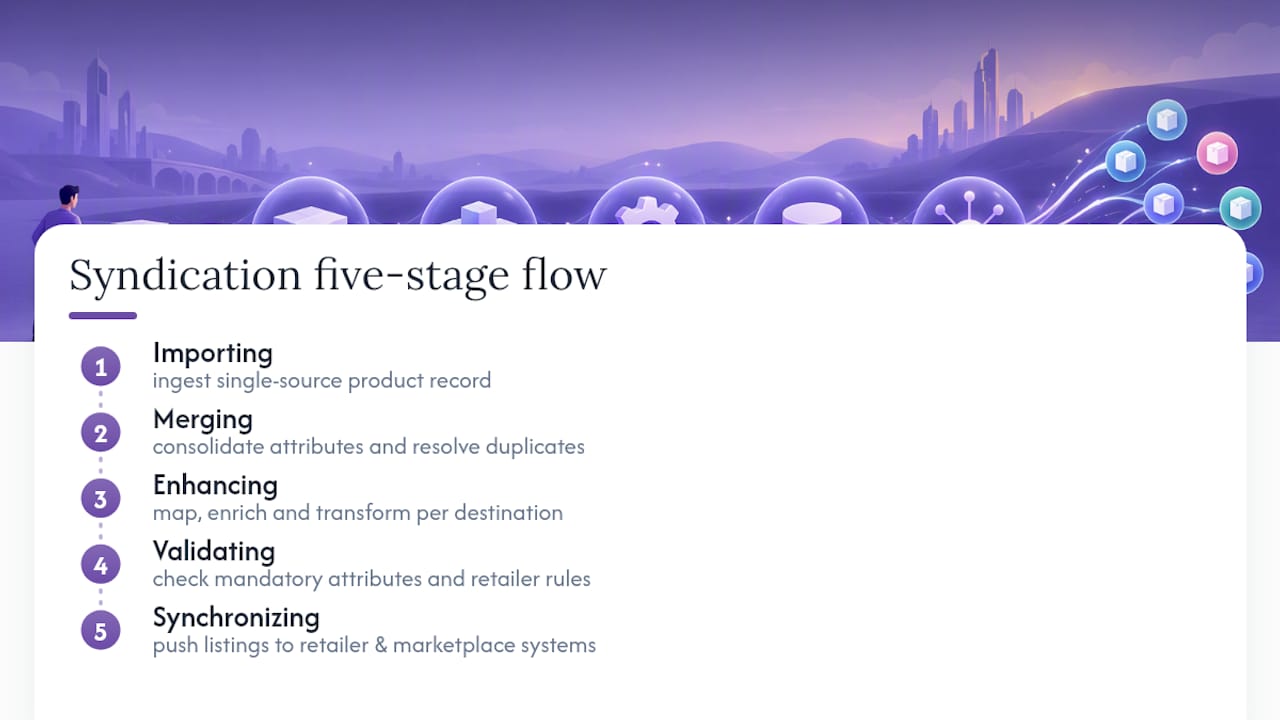
Product data syndication takes a single source of product truth and pushes it, transformed and validated, into dozens of retailer and marketplace systems at once. The Productsup glossary describes it as the combined work of importing, merging, enhancing, validating, and synchronizing data so each destination receives listings that meet its own rules.
That last part is the piece most brands underestimate. A product page that reads perfectly on your own site can fail validation on Walmart Seller Center or get suppressed in Google Merchant Center because a single mandatory attribute is missing. Syndication exists precisely to catch that gap before it becomes a rejected feed or, worse, a live listing with wrong pricing or a broken image link.
The term itself is more marketing shorthand than fixed industry vocabulary. The formal discipline behind it draws on product information management (PIM), master data management (MDM), and GS1’s global data standards. Most practitioners use “syndication” and “distribution” interchangeably, but the standards bodies and retailer specs behind the process are precise and unforgiving. Get the mechanics right, and a new SKU can go from spreadsheet to shelf on ten channels within days.
Benefits: Why Teams Invest in Product Data Syndication
Speed is the first payoff. A brand launching 200 SKUs across five marketplaces manually might spend weeks re-entering data per channel. A syndication pipeline compresses that into a single mapping and push cycle, and it scales the same way whether you’re adding one retailer or twenty.
Consistency follows close behind. Every channel enforces its own taxonomy, but the underlying product facts, dimensions, materials, ingredients, should never contradict each other from one listing to the next. Syndication enforces that discipline automatically instead of relying on someone remembering to update six spreadsheets.
Optimized, consistent content also moves the sales needle directly. Salsify’s research on product content found that improved content correlates with measurable sales lift across large catalogs.
The benefits stack up in a few concrete ways:
Faster time to market across every active channel
Fewer feed errors and fewer manual re-submissions
Lower return rates when descriptions and images match reality
Real operational time savings for catalog and marketing teams
Pro Tip: Track your feed error rate before and after implementing syndication. That single number tells you more about ROI than any content grade or vanity metric.
Core Components of a Syndication Stack
A working syndication setup rests on five pieces, and skipping any one of them is where most brands run into trouble.
Master data and enrichment (PIM/MDM): the single source of truth for descriptions, specs, and imagery, kept separate from any one channel’s formatting rules.
Mapping and templating: rules that translate your internal fields into each channel’s expected schema, whether that’s Google’s
google_product_categoryor Walmart’s Spec Product Type.Validation engine: automated checks that catch missing GTINs, malformed prices, or oversized images before a feed ever reaches a retailer.
Connectors and delivery: the pipes moving data out, typically API, SFTP, or a GDSN-certified data pool.
Media and enhanced content: rich imagery, A+ content, and video assets that increasingly determine ranking on the digital shelf as much as price does.
Most mid-size catalogs run all five inside a single PIM/PXM platform. Larger, multi-brand operations often split validation and connectors into a separate layer so channel additions don’t require touching the core data model.
How Product Data Syndication Works, Step by Step
The mechanics follow a repeatable sequence, whether you’re syndicating 50 SKUs or 50,000.
Ingest and consolidate. Pull product data from ERP, spreadsheets, and supplier feeds into one staging area.
Master and govern identifiers. Assign or confirm GTINs and GLNs so every trading partner references the same product and location. GDSN uses these identifiers to create what GS1 calls a single point of truth between partners, according to the GDSN Trade Item Implementation Guide.
Map fields and taxonomies. Translate internal attributes into each destination’s schema, category tree, and naming conventions.
Transform and validate content. Resize images, reformat descriptions, and run rule checks against mandatory fields.
Deliver via connectors. Push through API, SFTP, or a certified data pool, depending on what each channel supports.
Monitor acceptances and errors. Watch feed dashboards for rejections and fix root causes, not just symptoms.
Optimize post-publish. Use early performance data to prioritize which SKUs need richer content next.
Pro Tip: Never push a full catalog on the first attempt. A small-batch test to one retailer surfaces mapping and format problems far faster than watching 10,000 SKUs fail at once, a lesson baked into Walmart’s own bulk setup guidance.
Which Standards and Channel Specs Actually Matter?
GS1 and GDSN sit underneath almost every retailer’s data requirements, even when the retailer never mentions them by name. GDSN is built around the GS1 Global Registry, certified data pools, and a shared data quality framework, which lets one validated product record flow to multiple trading partners without re-entry, per the GDSN Trade Item Implementation Guide.
The GS1 Global Data Model goes a step further, defining which attributes are mandatory versus conditionally mandatory depending on product category and market. Mapping your PIM fields to the model’s BMS IDs cuts down on the guesswork of “does this retailer actually need this field.”
Individual retailers layer their own rules on top. Google Merchant Center will disapprove listings missing attributes like gtin or google_product_category, according to Google’s own formatting guidance. Walmart Seller Center requires specific columns tied to a product’s Spec Product Type, and skipping a required field generates a feed error that blocks the item entirely, per Walmart’s setup guide.
On the delivery side, most retailers accept CSV, XML, or JSON files over SFTP or API, and some support compressed uploads to speed processing, which the Criteo feed guide documents in detail, including processing windows that can run close to 24 hours. The pattern across every channel is the same:
Identifiers (GTIN, GLN) anchor the record
Category and taxonomy mapping determines where it appears
Country of origin and compliance fields are increasingly mandatory, not optional
Missing any one of these is the single most common cause of disapproval
Your Implementation Checklist Before Going Live
Run this sequence before the first full-catalog push, and repeat the monitoring steps on an ongoing basis.
Confirm GTIN coverage across every SKU, including variants and bundles.
Audit images and descriptions against each channel’s minimum resolution and character requirements.
Map categories and taxonomies channel by channel, not once for all.
Run a sandbox or small-batch push to one retailer before touching the full catalog.
Set up feed error dashboards so rejections surface within hours, not days.
Assign governance roles: who owns updates, who approves pricing changes, who handles rollback if a push goes wrong.
Document a rollback plan for any feed that publishes bad data live.
The recurring pitfalls are predictable: variant mismaps where a color or size points to the wrong parent SKU, conflicting prices between channels, and taxonomy gaps that leave a product uncategorized and invisible.
Pro Tip: A lightweight MVP pipeline for your highest-priority launch SKUs, running alongside full governance work for the rest of the catalog, gets new products live faster without sacrificing eventual data quality across the whole assortment.
How Do You Measure Syndication Success?
Once listings are live, the job shifts from publishing to monitoring. A handful of KPIs tell you almost everything you need to know.
Acceptance rate: the percentage of submitted SKUs that clear validation on the first attempt.
Feed error rate: how often submissions bounce back, and why.
Impressions and click-through rate: whether the content is even getting seen.
Conversion rate and return rate: the ultimate test of whether the content matched the product.
Content grading and A/B testing on titles, images, and bullet points let teams prioritize enrichment where it moves revenue most, rather than polishing every SKU equally. The eZdia whitepaper on content ROI frames product content as a digital sales rep, and treats measurement frameworks as the way to prove that investment pays off.
| Acceptance rate | Feed quality at submission |
| Feed error rate | Where mapping or validation breaks down |
| Conversion rate | Whether content matches buyer intent |
| Return rate | Whether content set accurate expectations |
Feed back into PIM governance so the fixes stick instead of repeating every cycle.
When Does a Managed Partner Beat Building In-House?
Building a full syndication stack takes real engineering time, and most brands don’t have a spare data team sitting around waiting for a new retailer relationship. That’s the exact gap a managed partner fills.
The evaluation criteria are simple: does the partner have a genuine retailer network, can it move fast, and does it show measurable outcomes rather than promises. A managed partner’s track record might include large wholesale GMV volumes and introductions to thousands of retailers across many markets, with buyer outreach starting in a few weeks. A managed partner like this integrates alongside your PIM work rather than replacing it, handling buyer relationships while your syndication pipeline handles the data mechanics.
Security and Data Privacy in Product Data Syndication
Product data syndication moves more than descriptions and images across the wire. Pricing, supplier terms, and sometimes customer-facing promotional data pass through connectors to third-party retailer systems, and each hop is a point where something can go wrong.
API keys and SFTP credentials deserve the same treatment as any other production secret: rotated regularly, scoped to the minimum access needed, and never shared across environments. A connector with blanket write access to your entire catalog is a bigger risk than one scoped to a single feed type.
Data quality frameworks built into GDSN, including the GS1 Data Quality Framework referenced in the trade item implementation guide, exist partly for accuracy and partly for accountability. Every certified data pool tracks which trading partner submitted which version of a record, which matters when a pricing error or compliance issue needs tracing back to its source.

Retailer-specific compliance adds another layer. Some categories, food, cosmetics, children’s products, carry regulatory disclosure requirements that vary by market. Syndicating the wrong country-of-origin or ingredient data isn’t just a technical error; it can trigger real compliance exposure depending on the destination market’s rules.
Access governance matters as much as encryption. Who inside your organization can push a live price change to a marketplace feed? Who can approve a new SKU going live without review? A syndication platform without role-based permissions puts too much power in too many hands, and the fix is usually organizational before it’s technical: define who owns what, then let the tooling enforce it.
What Software and Tools Handle Syndication Today?
The tooling landscape splits into a few categories, and most brands end up combining more than one.
PIM/PXM platforms form the foundation for most mid-size and enterprise catalogs, centralizing master data, enrichment workflows, and channel-specific templating in one system. These platforms typically include built-in connectors for major marketplaces and retailers, reducing the custom integration work needed for each new channel.
GDSN-certified data pools serve a more specific purpose: synchronizing trade item data directly with retail trading partners under the GS1 standard. Brands selling into large grocery, retail, or distribution networks often need a certified data pool relationship regardless of what PIM they run internally, since many major retailers only accept data through this channel for certain categories.
Marketplace-native tools like Google Merchant Center and Walmart Seller Center handle the last mile: accepting feeds, running their own validation, and surfacing rejection reasons. These aren’t full syndication platforms on their own, but understanding their specific feed requirements shapes how you configure everything upstream.
Order and catalog management integrations connect syndicated product data to the commercial side, linking what’s listed to what’s sellable and in stock. A wholesale order management layer that talks to your catalog data prevents the common failure mode where a product syndicates perfectly but the order can’t actually be fulfilled.
Choosing between these isn’t about picking the “best” one. It’s about matching tooling to catalog size, channel count, and how much custom mapping your product categories genuinely require.
Who Owns What in the Syndication Process?
Syndication fails most often not from bad technology but from unclear ownership. A handful of roles need to be explicit from the start.
Product/catalog managers own the master data itself, the descriptions, specs, and imagery that everything else derives from. They’re the ones who decide what “correct” looks like before any mapping happens.
Data or PIM administrators own the mapping and validation layer, translating master records into each channel’s schema and running the rule checks that catch errors before submission. This role usually catches the GTIN gaps and taxonomy mismatches before they become live rejections.
Marketplace or channel managers own the relationship with each retailer or marketplace, tracking acceptance rates, resolving disputes, and staying current on spec changes. Retailer requirements shift, and someone needs to be watching for it.
IT or integration teams own the connectors themselves, API uptime, SFTP credentials, and the technical plumbing that moves data from the PIM to each destination.
Commercial or sales leadership owns the prioritization question: which SKUs go where first, and which retailer relationships matter most to pursue. A distributor management function often sits closest to this decision, since it sees downstream demand signals that catalog teams don’t always have visibility into.
Smaller teams collapse several of these into one person. Larger organizations split them across departments entirely. Either way, write down who owns each handoff, because the moments where syndication breaks are almost always the moments where two roles both assumed the other one was checking.
The Next Shift: AI, Schema, and the Digital Shelf
Structured schema markup on product pages is no longer optional if you want AI-driven discovery tools to surface your listings accurately. Retailers are increasingly using automated rules, driven by their own performance signals, to flag mapping errors before a human ever looks at the feed.
The practical move is to prioritize schema completeness and mapping automation on your highest-volume SKUs first. Chasing perfect data on your entire catalog before fixing your top sellers is exactly backwards, and it’s the mistake most teams make when governance work outpaces prioritization.
A Faster Path to Retail Shelves
Building the full syndication stack described above, the PIM, the mapping rules, the validation engine, takes real time and a dedicated data team. If your priority right now is getting a new product line in front of actual retail buyers rather than perfecting every feed connector, that’s a different problem, and it’s the one Kingpin was built to solve.
Kingpin’s research agent finds the retailers that fit the brand in every market, and its sales coordinator agent reaches their buyers in their language. Every buyer relationship stays with the brand, and there’s 0% commission alongside one monthly fee. The monthly fee is set on the strategy call.
If your catalog is syndication-ready but your buyer pipeline isn’t, visit the Kingpin brand solutions page to learn how its AI-powered wholesale team works.
Sources
Keep these close when you’re building mappings or troubleshooting a rejected feed.
FAQ
What Are Examples of Syndicated Data?
Syndicated data typically includes product titles, descriptions, images, pricing, GTINs, and category attributes pushed from a central PIM to channels like Google Merchant Center, Walmart Seller Center, and GDSN-certified data pools. Enhanced content like size charts, video, and A+ modules counts too when a channel supports it.
What Does It Mean to Syndicate Data?
Syndicating data means taking one master product record and distributing formatted, validated copies of it to multiple external destinations at once. Each destination receives content that meets its own attribute and format rules rather than a generic export.
Can You Give an Example of Content Syndication in Retail?
A brand launching a new skincare line might master its product data once, then syndicate it simultaneously to its own e-commerce site, Google Merchant Center, and several marketplace and distributor feeds. Each channel gets the same core facts formatted to its own taxonomy and mandatory fields, based on standards like the GS1 Global Data Model.
Is Content Syndication Still Effective?
Yes. Optimized, consistently syndicated product content continues to show measurable sales impact across large catalogs, according to Salsify’s research on product content. As AI-driven discovery and structured schema grow more important, accurate syndicated data becomes more valuable, not less.
How Much Does Kingpin Cost for Brands Needing Retail Distribution?
Kingpin charges one monthly fee on every plan, set on the strategy call, with 0% commission.
Product data syndication is the process of preparing one master product record and distributing it, correctly formatted, to every retail and marketplace channel a brand sells through. GS1 identifiers and the GDSN network make this possible at scale, and the outcome is straightforward: channel-ready listings, fewer disapprovals, and faster time to market.
TL;DR:
Proper product data syndication ensures thousands of SKUs can be published across multiple channels within days, not weeks.
Mandatory attributes like GTINs and category mapping are the most common causes of feed disapproval, especially when missing or mismatched.
A complete syndication stack includes master data management, mapping, validation, connectors, and rich content, all integrated within a single platform or layered.
Running small-batch tests before full catalog pushes significantly reduces errors, helping brands catch issues early with individual retailers.
Fees, error rates, acceptance, and click-through metrics offer key insights into syndication effectiveness and guide ongoing content optimization.
KingpinReach More Retail BuyersKingpin helps consumer brands connect with relevant global retailers while keeping ownership of their buyer relationships.Explore Kingpin
Table of Contents
What Is Product Data Syndication and Why Does It Matter?
Benefits: Why Teams Invest in Product Data Syndication
Core Components of a Syndication Stack
How Product Data Syndication Works, Step by Step
Which Standards and Channel Specs Actually Matter?
Your Implementation Checklist Before Going Live
How Do You Measure Syndication Success?
When Does a Managed Partner Beat Building In-House?
Security and Data Privacy in Product Data Syndication
What Software and Tools Handle Syndication Today?
Who Owns What in the Syndication Process?
The Next Shift: AI, Schema, and the Digital Shelf
A Faster Path to Retail Shelves
Sources
FAQ
What Is Product Data Syndication and Why Does It Matter?
Product data syndication takes a single source of product truth and pushes it, transformed and validated, into dozens of retailer and marketplace systems at once. The Productsup glossary describes it as the combined work of importing, merging, enhancing, validating, and synchronizing data so each destination receives listings that meet its own rules.
That last part is the piece most brands underestimate. A product page that reads perfectly on your own site can fail validation on Walmart Seller Center or get suppressed in Google Merchant Center because a single mandatory attribute is missing. Syndication exists precisely to catch that gap before it becomes a rejected feed or, worse, a live listing with wrong pricing or a broken image link.
The term itself is more marketing shorthand than fixed industry vocabulary. The formal discipline behind it draws on product information management (PIM), master data management (MDM), and GS1’s global data standards. Most practitioners use “syndication” and “distribution” interchangeably, but the standards bodies and retailer specs behind the process are precise and unforgiving. Get the mechanics right, and a new SKU can go from spreadsheet to shelf on ten channels within days.
Benefits: Why Teams Invest in Product Data Syndication
Speed is the first payoff. A brand launching 200 SKUs across five marketplaces manually might spend weeks re-entering data per channel. A syndication pipeline compresses that into a single mapping and push cycle, and it scales the same way whether you’re adding one retailer or twenty.
Consistency follows close behind. Every channel enforces its own taxonomy, but the underlying product facts, dimensions, materials, ingredients, should never contradict each other from one listing to the next. Syndication enforces that discipline automatically instead of relying on someone remembering to update six spreadsheets.
Optimized, consistent content also moves the sales needle directly. Salsify’s research on product content found that improved content correlates with measurable sales lift across large catalogs.
The benefits stack up in a few concrete ways:
Faster time to market across every active channel
Fewer feed errors and fewer manual re-submissions
Lower return rates when descriptions and images match reality
Real operational time savings for catalog and marketing teams
Pro Tip: Track your feed error rate before and after implementing syndication. That single number tells you more about ROI than any content grade or vanity metric.
Core Components of a Syndication Stack
A working syndication setup rests on five pieces, and skipping any one of them is where most brands run into trouble.
Master data and enrichment (PIM/MDM): the single source of truth for descriptions, specs, and imagery, kept separate from any one channel’s formatting rules.
Mapping and templating: rules that translate your internal fields into each channel’s expected schema, whether that’s Google’s
google_product_categoryor Walmart’s Spec Product Type.Validation engine: automated checks that catch missing GTINs, malformed prices, or oversized images before a feed ever reaches a retailer.
Connectors and delivery: the pipes moving data out, typically API, SFTP, or a GDSN-certified data pool.
Media and enhanced content: rich imagery, A+ content, and video assets that increasingly determine ranking on the digital shelf as much as price does.
Most mid-size catalogs run all five inside a single PIM/PXM platform. Larger, multi-brand operations often split validation and connectors into a separate layer so channel additions don’t require touching the core data model.
How Product Data Syndication Works, Step by Step
The mechanics follow a repeatable sequence, whether you’re syndicating 50 SKUs or 50,000.
Ingest and consolidate. Pull product data from ERP, spreadsheets, and supplier feeds into one staging area.
Master and govern identifiers. Assign or confirm GTINs and GLNs so every trading partner references the same product and location. GDSN uses these identifiers to create what GS1 calls a single point of truth between partners, according to the GDSN Trade Item Implementation Guide.
Map fields and taxonomies. Translate internal attributes into each destination’s schema, category tree, and naming conventions.
Transform and validate content. Resize images, reformat descriptions, and run rule checks against mandatory fields.
Deliver via connectors. Push through API, SFTP, or a certified data pool, depending on what each channel supports.
Monitor acceptances and errors. Watch feed dashboards for rejections and fix root causes, not just symptoms.
Optimize post-publish. Use early performance data to prioritize which SKUs need richer content next.
Pro Tip: Never push a full catalog on the first attempt. A small-batch test to one retailer surfaces mapping and format problems far faster than watching 10,000 SKUs fail at once, a lesson baked into Walmart’s own bulk setup guidance.
Which Standards and Channel Specs Actually Matter?
GS1 and GDSN sit underneath almost every retailer’s data requirements, even when the retailer never mentions them by name. GDSN is built around the GS1 Global Registry, certified data pools, and a shared data quality framework, which lets one validated product record flow to multiple trading partners without re-entry, per the GDSN Trade Item Implementation Guide.
The GS1 Global Data Model goes a step further, defining which attributes are mandatory versus conditionally mandatory depending on product category and market. Mapping your PIM fields to the model’s BMS IDs cuts down on the guesswork of “does this retailer actually need this field.”
Individual retailers layer their own rules on top. Google Merchant Center will disapprove listings missing attributes like gtin or google_product_category, according to Google’s own formatting guidance. Walmart Seller Center requires specific columns tied to a product’s Spec Product Type, and skipping a required field generates a feed error that blocks the item entirely, per Walmart’s setup guide.
On the delivery side, most retailers accept CSV, XML, or JSON files over SFTP or API, and some support compressed uploads to speed processing, which the Criteo feed guide documents in detail, including processing windows that can run close to 24 hours. The pattern across every channel is the same:
Identifiers (GTIN, GLN) anchor the record
Category and taxonomy mapping determines where it appears
Country of origin and compliance fields are increasingly mandatory, not optional
Missing any one of these is the single most common cause of disapproval
Your Implementation Checklist Before Going Live
Run this sequence before the first full-catalog push, and repeat the monitoring steps on an ongoing basis.
Confirm GTIN coverage across every SKU, including variants and bundles.
Audit images and descriptions against each channel’s minimum resolution and character requirements.
Map categories and taxonomies channel by channel, not once for all.
Run a sandbox or small-batch push to one retailer before touching the full catalog.
Set up feed error dashboards so rejections surface within hours, not days.
Assign governance roles: who owns updates, who approves pricing changes, who handles rollback if a push goes wrong.
Document a rollback plan for any feed that publishes bad data live.
The recurring pitfalls are predictable: variant mismaps where a color or size points to the wrong parent SKU, conflicting prices between channels, and taxonomy gaps that leave a product uncategorized and invisible.
Pro Tip: A lightweight MVP pipeline for your highest-priority launch SKUs, running alongside full governance work for the rest of the catalog, gets new products live faster without sacrificing eventual data quality across the whole assortment.
How Do You Measure Syndication Success?
Once listings are live, the job shifts from publishing to monitoring. A handful of KPIs tell you almost everything you need to know.
Acceptance rate: the percentage of submitted SKUs that clear validation on the first attempt.
Feed error rate: how often submissions bounce back, and why.
Impressions and click-through rate: whether the content is even getting seen.
Conversion rate and return rate: the ultimate test of whether the content matched the product.
Content grading and A/B testing on titles, images, and bullet points let teams prioritize enrichment where it moves revenue most, rather than polishing every SKU equally. The eZdia whitepaper on content ROI frames product content as a digital sales rep, and treats measurement frameworks as the way to prove that investment pays off.
| Acceptance rate | Feed quality at submission |
| Feed error rate | Where mapping or validation breaks down |
| Conversion rate | Whether content matches buyer intent |
| Return rate | Whether content set accurate expectations |
Feed back into PIM governance so the fixes stick instead of repeating every cycle.
When Does a Managed Partner Beat Building In-House?
Building a full syndication stack takes real engineering time, and most brands don’t have a spare data team sitting around waiting for a new retailer relationship. That’s the exact gap a managed partner fills.
The evaluation criteria are simple: does the partner have a genuine retailer network, can it move fast, and does it show measurable outcomes rather than promises. A managed partner’s track record might include large wholesale GMV volumes and introductions to thousands of retailers across many markets, with buyer outreach starting in a few weeks. A managed partner like this integrates alongside your PIM work rather than replacing it, handling buyer relationships while your syndication pipeline handles the data mechanics.
Security and Data Privacy in Product Data Syndication
Product data syndication moves more than descriptions and images across the wire. Pricing, supplier terms, and sometimes customer-facing promotional data pass through connectors to third-party retailer systems, and each hop is a point where something can go wrong.
API keys and SFTP credentials deserve the same treatment as any other production secret: rotated regularly, scoped to the minimum access needed, and never shared across environments. A connector with blanket write access to your entire catalog is a bigger risk than one scoped to a single feed type.
Data quality frameworks built into GDSN, including the GS1 Data Quality Framework referenced in the trade item implementation guide, exist partly for accuracy and partly for accountability. Every certified data pool tracks which trading partner submitted which version of a record, which matters when a pricing error or compliance issue needs tracing back to its source.
Retailer-specific compliance adds another layer. Some categories, food, cosmetics, children’s products, carry regulatory disclosure requirements that vary by market. Syndicating the wrong country-of-origin or ingredient data isn’t just a technical error; it can trigger real compliance exposure depending on the destination market’s rules.
Access governance matters as much as encryption. Who inside your organization can push a live price change to a marketplace feed? Who can approve a new SKU going live without review? A syndication platform without role-based permissions puts too much power in too many hands, and the fix is usually organizational before it’s technical: define who owns what, then let the tooling enforce it.
What Software and Tools Handle Syndication Today?
The tooling landscape splits into a few categories, and most brands end up combining more than one.
PIM/PXM platforms form the foundation for most mid-size and enterprise catalogs, centralizing master data, enrichment workflows, and channel-specific templating in one system. These platforms typically include built-in connectors for major marketplaces and retailers, reducing the custom integration work needed for each new channel.
GDSN-certified data pools serve a more specific purpose: synchronizing trade item data directly with retail trading partners under the GS1 standard. Brands selling into large grocery, retail, or distribution networks often need a certified data pool relationship regardless of what PIM they run internally, since many major retailers only accept data through this channel for certain categories.
Marketplace-native tools like Google Merchant Center and Walmart Seller Center handle the last mile: accepting feeds, running their own validation, and surfacing rejection reasons. These aren’t full syndication platforms on their own, but understanding their specific feed requirements shapes how you configure everything upstream.
Order and catalog management integrations connect syndicated product data to the commercial side, linking what’s listed to what’s sellable and in stock. A wholesale order management layer that talks to your catalog data prevents the common failure mode where a product syndicates perfectly but the order can’t actually be fulfilled.
Choosing between these isn’t about picking the “best” one. It’s about matching tooling to catalog size, channel count, and how much custom mapping your product categories genuinely require.
Who Owns What in the Syndication Process?
Syndication fails most often not from bad technology but from unclear ownership. A handful of roles need to be explicit from the start.
Product/catalog managers own the master data itself, the descriptions, specs, and imagery that everything else derives from. They’re the ones who decide what “correct” looks like before any mapping happens.
Data or PIM administrators own the mapping and validation layer, translating master records into each channel’s schema and running the rule checks that catch errors before submission. This role usually catches the GTIN gaps and taxonomy mismatches before they become live rejections.
Marketplace or channel managers own the relationship with each retailer or marketplace, tracking acceptance rates, resolving disputes, and staying current on spec changes. Retailer requirements shift, and someone needs to be watching for it.
IT or integration teams own the connectors themselves, API uptime, SFTP credentials, and the technical plumbing that moves data from the PIM to each destination.
Commercial or sales leadership owns the prioritization question: which SKUs go where first, and which retailer relationships matter most to pursue. A distributor management function often sits closest to this decision, since it sees downstream demand signals that catalog teams don’t always have visibility into.
Smaller teams collapse several of these into one person. Larger organizations split them across departments entirely. Either way, write down who owns each handoff, because the moments where syndication breaks are almost always the moments where two roles both assumed the other one was checking.
The Next Shift: AI, Schema, and the Digital Shelf
Structured schema markup on product pages is no longer optional if you want AI-driven discovery tools to surface your listings accurately. Retailers are increasingly using automated rules, driven by their own performance signals, to flag mapping errors before a human ever looks at the feed.
The practical move is to prioritize schema completeness and mapping automation on your highest-volume SKUs first. Chasing perfect data on your entire catalog before fixing your top sellers is exactly backwards, and it’s the mistake most teams make when governance work outpaces prioritization.
A Faster Path to Retail Shelves
Building the full syndication stack described above, the PIM, the mapping rules, the validation engine, takes real time and a dedicated data team. If your priority right now is getting a new product line in front of actual retail buyers rather than perfecting every feed connector, that’s a different problem, and it’s the one Kingpin was built to solve.
Kingpin’s research agent finds the retailers that fit the brand in every market, and its sales coordinator agent reaches their buyers in their language. Every buyer relationship stays with the brand, and there’s 0% commission alongside one monthly fee. The monthly fee is set on the strategy call.
If your catalog is syndication-ready but your buyer pipeline isn’t, visit the Kingpin brand solutions page to learn how its AI-powered wholesale team works.
Sources
Keep these close when you’re building mappings or troubleshooting a rejected feed.
FAQ
What Are Examples of Syndicated Data?
Syndicated data typically includes product titles, descriptions, images, pricing, GTINs, and category attributes pushed from a central PIM to channels like Google Merchant Center, Walmart Seller Center, and GDSN-certified data pools. Enhanced content like size charts, video, and A+ modules counts too when a channel supports it.
What Does It Mean to Syndicate Data?
Syndicating data means taking one master product record and distributing formatted, validated copies of it to multiple external destinations at once. Each destination receives content that meets its own attribute and format rules rather than a generic export.
Can You Give an Example of Content Syndication in Retail?
A brand launching a new skincare line might master its product data once, then syndicate it simultaneously to its own e-commerce site, Google Merchant Center, and several marketplace and distributor feeds. Each channel gets the same core facts formatted to its own taxonomy and mandatory fields, based on standards like the GS1 Global Data Model.
Is Content Syndication Still Effective?
Yes. Optimized, consistently syndicated product content continues to show measurable sales impact across large catalogs, according to Salsify’s research on product content. As AI-driven discovery and structured schema grow more important, accurate syndicated data becomes more valuable, not less.
How Much Does Kingpin Cost for Brands Needing Retail Distribution?
Kingpin charges one monthly fee on every plan, set on the strategy call, with 0% commission.
About The Author

Ysabella Louise
Hi, I'm Ysabella, PMM at Kingpin. We believe that growing revenue shouldn't be a challenge, it should be a no-brainer. So sales teams can focus less on the struggle and more on the wins. I'm here to make sure that vision comes through in every story we tell, and to share what's working, what's changing, and what you should actually know to sell smarter.