Measure B2B Trade Show ROI Over 18–24 Months and When to Use Kingpin

Trade shows can deliver strong returns, but only when the offer fits the room and the measurement policy is set before the booth ships. Check three numbers first: cost-per-qualified-meeting, attributed pipeline value at a defined window, and time-weighted ROI. Sales-cycle length changes everything here, since a 90-day attribution window will understate a show that feeds an 18-month enterprise deal.
TL;DR:
Using a 180-day to 24-month attribution window is essential for accurately measuring ROI of long-cycle or international trade shows.
Focus on qualified meetings and pipeline value, not just badge scans or leads, to avoid overestimating actual sales potential.
Pre-show planning should include validating the audience, pre-booking meetings, and assigning a meeting owner to streamline follow-up.
Deduct 15% to 25% of attributed revenue for trade costs when evaluating export-focused trade show ROI before calculating profit.
Consider an AI-powered wholesale team like Kingpin to find best-fit retailers and reach their buyers without relying solely on physical trade shows.
KingpinReach Relevant Retail BuyersKingpin helps consumer brands find the right retailers and reach their buyers in their language, without relying solely on costly traditional trade shows.See how Kingpin helps
Table of Contents
Which metrics actually define trade show ROI?
How to calculate trade show ROI step by step
What to do before, during, and after the show
How attribution windows change what the numbers tell you
Benchmarks, hidden costs, and when to drop a show
What the research says should change how you measure
How should marketing teams actually treat trade shows now
Where Kingpin fits alongside your trade show budget
Sources
FAQ
Which metrics actually define trade show ROI?
Marketing teams often report badge scans as leads, and that gap between activity and outcome is where most ROI conversations go wrong. A badge scan is a name and an email. A lead is someone who took an action showing intent. A qualified lead meets defined fit criteria (budget, authority, need, timeline). A qualified meeting is a scheduled, attended conversation with a person who can buy or influence the purchase. Each stage needs its own count, because collapsing them into one “leads” number hides where a program is actually leaking value.
The core metrics to track:
Cost-per-qualified-lead (CPQL): total show investment divided by leads that survive qualification, not raw scans.
Cost-per-qualified-meeting (CPQM): total show investment divided by scheduled, attended meetings with qualified buyers.
Pipeline value at a set window: attributed opportunity value created within 90 days, 180 days, or a longer cohort period for complex sales.
Lead-to-revenue conversion rate: the share of qualified leads that close, tracked by cohort rather than by calendar month.
Customer acquisition cost (CAC) for show-sourced customers, compared against CAC from other channels.
Time-weighted ROI: return calculated against the actual close timeline rather than a fixed reporting period.
Marketing and finance tend to want different views of the same event. Marketing reports activity metrics quickly: leads captured, meetings booked, cost per lead. Finance wants attributed revenue and net ROI, which can take months or years to materialize for longer sales cycles. Both views are legitimate, but a program only proves its value when the two get reconciled through a shared cohort report.
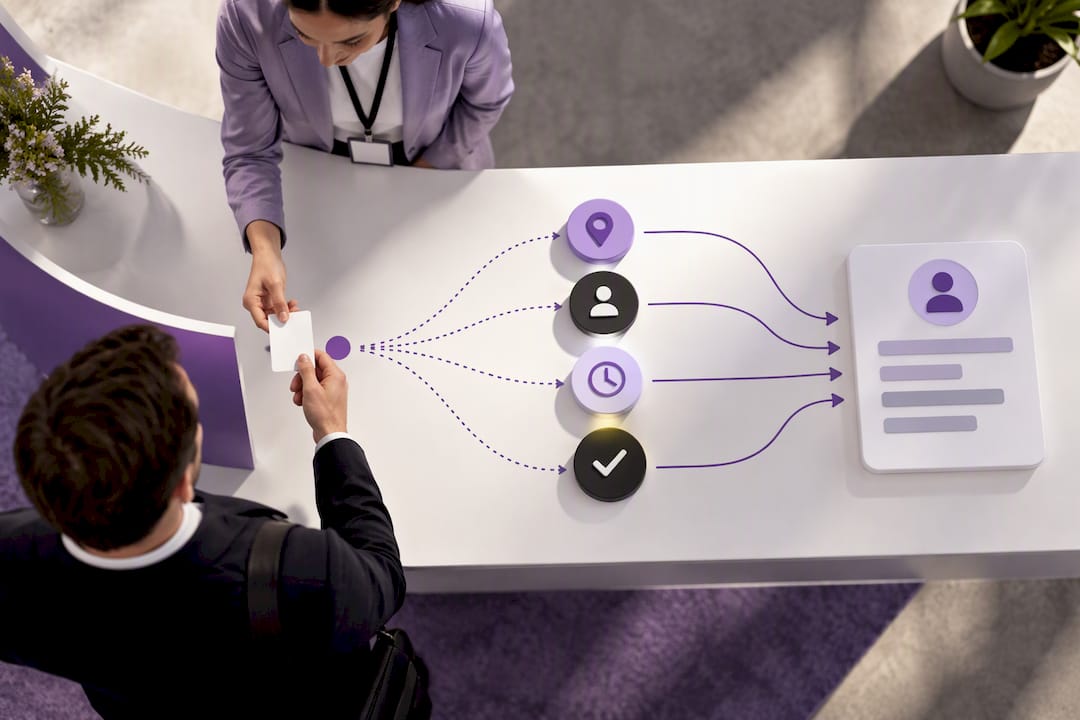
None of this works without disciplined data capture at the point of contact. Every lead record needs a source tag identifying the specific show, a meeting owner assigned in real time, a timestamp for first contact, and, for export-heavy programs, a compliance flag showing whether the contact cleared screening. Skipping any of these fields at the booth means rebuilding attribution from memory weeks later, and that rarely ends well.
How to calculate trade show ROI step by step
The formula itself is simple: (Revenue minus Investment) divided by Investment, expressed as a percentage. The Cvent blog on trade show ROI walks through this calculation and recommends including non-sales wins, such as partnership introductions, when the sales cycle runs long. Getting a defensible number takes more discipline than the formula suggests.
Total the all-in cost. Add booth space, design and build, shipping and drayage, travel and lodging, staff time valued at loaded salary, pre-show outreach spend, and promotional materials.
Set an attribution policy before the show, not after. Choose first-touch, multi-touch, or time-decay attribution and document which one applies to which deal type.
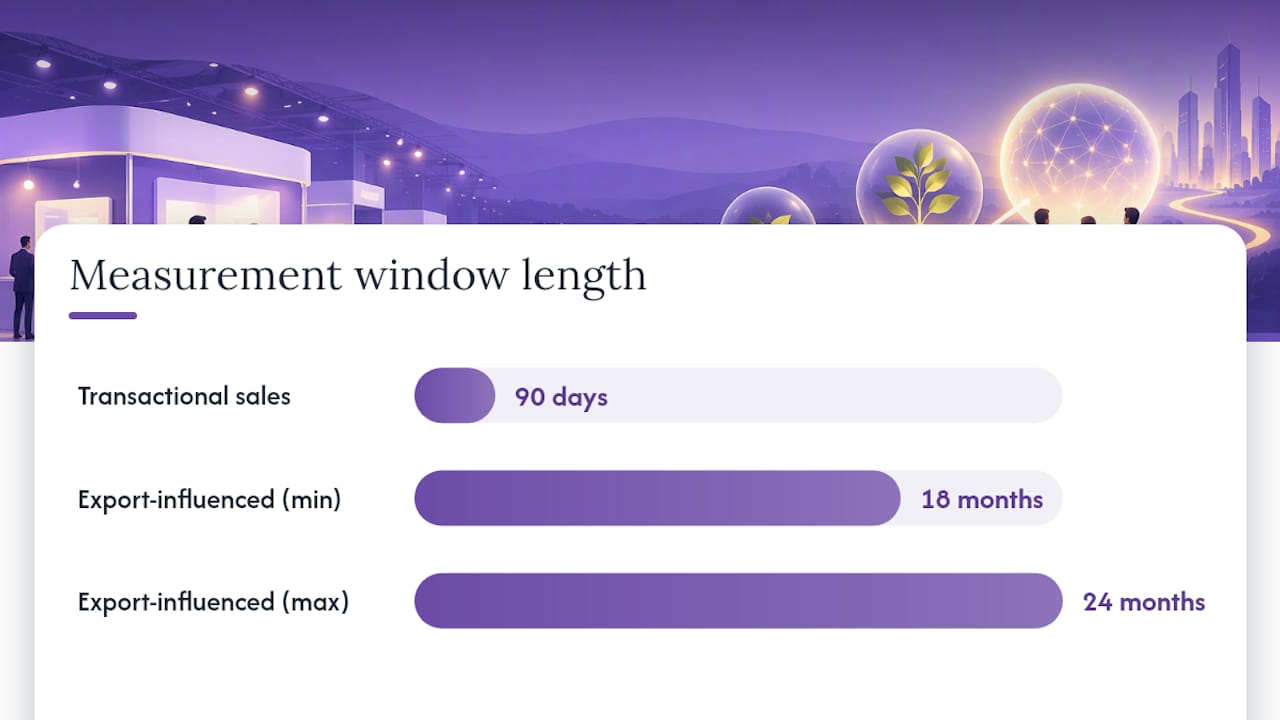
Pick your window. A 90-day window works for transactional sales. Complex B2B and export deals need longer.
Calculate attributable revenue using your chosen policy, then deduct trade costs where relevant.
Apply the ROI formula to get a percentage return, and re-run it at each reporting checkpoint as more deals close.
For export-focused exhibitors, Reevol Academy’s trade fair ROI guidance recommends deducting 15% to 25% of attributed revenue to account for trade costs such as tariffs, agent commissions, and currency conversion before calculating final ROI.
Statistic Callout: Reevol Academy recommends measuring export-influenced trade fair revenue over an 18 to 24 month window rather than a standard quarterly cycle, because international deals routinely take that long to move from first contact to signed order.
Say a show costs tens of thousands of dollars all-in and produces several hundred thousand dollars in attributed revenue within an 18-month cohort window for an export-heavy program. Deducting a trade cost percentage for fees and tariffs leaves a substantial net attributable revenue. ROI comes out to a high multiple of the initial investment. Annualizing that figure across the 18-month close window gives a clearer year-over-year comparison than reporting the raw total against a single fiscal quarter.
What to do before, during, and after the show
ROI is decided mostly in the weeks before doors open and the days right after they close, not on the show floor itself.
Before the show:
Validate the audience list against your ideal customer profile before committing budget to the event.
Pre-book meetings with named accounts using outreach that starts four to six weeks ahead.
Staff the booth with people who can qualify on the spot, not just hand out materials.
Model the full cost using the line-item checklist from the calculation section above, before you sign the contract.
During the show:
Run a consistent qualification script at every conversation so data capture doesn’t depend on who’s staffing the booth.
Capture meeting outcomes in real time, including next steps and a named owner, rather than relying on notes written after the fact.
Use on-stand demos to secure a specific commitment, such as a scheduled follow-up call or a sample request.
After the show, the clock matters more than most teams admit. A Trade Show Lead Capture guide from Aesthetic Collective recommends a 48-hour follow-up window as the point past which response rates drop sharply. Route leads by tier: hot leads to sales same day, warm leads into a nurture sequence, and cold contacts into a longer-term email track. For export-heavy programs, run compliance screening on new contacts before they enter the CRM as qualified, since Reevol’s guidance ties CPQL specifically to leads that survive that screening step.
Pro Tip: Assign a named meeting owner to every booked conversation before the show starts, not after leads come in. It removes the single biggest cause of follow-up delay.
How attribution windows change what the numbers tell you
The reporting window you choose changes the story a show tells. A 30-day window shows early engagement but nothing about revenue. A 90-day window works well for transactional or short-cycle sales. A 180-day window starts to catch mid-length enterprise deals. Complex B2B and export programs need 18 to 24 months, per Reevol Academy’s cohort attribution model, which links lead capture through compliance screening, quote and order IDs, shipment records, and payment receipt dates.
Window | What it reveals | Best fit |
|---|---|---|
30 days | Early engagement and meeting volume | All programs, as a leading indicator |
90 days | Transactional revenue and fast-close deals | Short sales cycles |
180 days | Mid-length pipeline conversion | Standard B2B, non-export |
18-24 months | Full attributed revenue for complex or export deals | Long-cycle B2B, international trade |
Annualizing that figure lets you compare programs of different cycle lengths on equal footing.
Benchmarks, hidden costs, and when to drop a show
Those bands assume the hidden costs get counted, and most programs miss at least one of these:
Internal staff time valued at loaded salary, not treated as a sunk cost.
Lost sales capacity while reps staff the booth instead of working existing pipeline.
Pre-show outreach effort, including the hours spent building the pre-booked meeting list.
Post-show follow-up workload, which often exceeds the time spent at the show itself.
A quick break-even model divides total all-in cost by your average deal value and close rate to find the minimum qualified-lead volume the show needs to produce. If that number is higher than what your booth traffic and staffing can realistically deliver, the show is a candidate to drop before the next budget cycle.
What the research says should change how you measure
CEIR’s 2025 Performance Benchmark Playbooks, covered by IAEE’s reporting on intimate B2B exhibitions, found that smaller, more curated shows are outperforming larger events on profit margin, and that exhibitors treating a show as one stop in a continuous channel outperform those treating it as a single exposure.
Exhibitors who view events as continuous channels, rather than standalone exposures, consistently show stronger performance than those chasing a single show’s results.
Academic work on trade show performance, including the MSED 2020 paper on B2B exhibition activities, ties higher-quality visitor data capture and stronger on-stand negotiation directly to higher rates of signed post-show agreements. The pattern across this research is consistent: process discipline, not booth size, is what separates a profitable show from a break-even one.
How should marketing teams actually treat trade shows now
Treat every show as a compressed pipeline channel, not a brand exercise, and instrument it like one: tagged leads, a named meeting owner, a documented attribution window.
Some exhibitors are better served shifting part of that budget toward managed outreach instead. Kingpin’s record includes $700M+ in wholesale GMV since 2021 and 3,500+ retailers on Kingpin, proof points worth weighing against a single show’s uncertain pipeline.
Where Kingpin fits alongside your trade show budget
Kingpin exists for the parts of the buyer-finding process that a show floor handles inefficiently: finding the retailers that fit your brand and reaching their buyers in their language, without the fixed booth cost of an exhibition. Every buyer relationship stays with the brand, and Kingpin charges 0% commission.
Kingpin is worth considering alongside your show calendar when:
You want to reach buyers outside the show calendar, rather than waiting for the next relevant show date.
Your team is stretched thin on staffing a booth and can’t cover both the floor and existing pipeline.
You want to find retailers in a new market before committing show budget to it, using the kind of buyer targeting that avoids blanket outreach.
Kingpin charges one monthly fee on every plan, set on the strategy call, and 0% commission. Visit Kingpin to see whether its AI-powered wholesale team fits your current buyer-finding gap.
Sources
Trade-fair ROI measurement: from leads to attributed revenue | Reevol Academy
Evaluating performance of trade show activities as a marketing tool in the B2B market — MSED 2020
FAQ
Are trade shows worth it for a B2B company?
Trade shows can be worth it when the audience matches your ideal customer profile and you measure with the right attribution window, since a 90-day window can understate a show that actually feeds an 18-month enterprise sale. Programs treated as one stop in a continuous channel, per CEIR’s benchmarking, tend to outperform those judged on a single show’s results.
How do you calculate trade show ROI?
Total your all-in costs, decide an attribution policy and window before the show, calculate attributable revenue against that window, and apply (Revenue minus Investment) divided by Investment, as outlined in Cvent’s ROI guide. For export-heavy programs, deduct 15% to 25% for trade costs before finishing the calculation, per Reevol Academy.
What attribution window should I use for trade show leads?
Use 90 days for short, transactional sales cycles and 18 to 24 months for complex B2B or export deals, since Reevol Academy’s cohort model links lead capture through compliance, order, and payment records over that longer span. A shorter window will consistently understate long-cycle programs.
What’s a good trade show ROI benchmark?
Programs below that range are usually missing hidden costs like internal staff time or post-show follow-up workload in the calculation.
How can I speed up buyer introductions without a trade show?
Kingpin’s research agent finds the retailers that fit your brand, and its sales coordinator agent reaches their buyers in their language with the brand’s line sheet inside. On a strategy call, bring three shops you sell to and see the next ones that look like them. Every buyer relationship stays with the brand, and Kingpin charges 0% commission.
Trade shows can deliver strong returns, but only when the offer fits the room and the measurement policy is set before the booth ships. Check three numbers first: cost-per-qualified-meeting, attributed pipeline value at a defined window, and time-weighted ROI. Sales-cycle length changes everything here, since a 90-day attribution window will understate a show that feeds an 18-month enterprise deal.
TL;DR:
Using a 180-day to 24-month attribution window is essential for accurately measuring ROI of long-cycle or international trade shows.
Focus on qualified meetings and pipeline value, not just badge scans or leads, to avoid overestimating actual sales potential.
Pre-show planning should include validating the audience, pre-booking meetings, and assigning a meeting owner to streamline follow-up.
Deduct 15% to 25% of attributed revenue for trade costs when evaluating export-focused trade show ROI before calculating profit.
Consider an AI-powered wholesale team like Kingpin to find best-fit retailers and reach their buyers without relying solely on physical trade shows.
KingpinReach Relevant Retail BuyersKingpin helps consumer brands find the right retailers and reach their buyers in their language, without relying solely on costly traditional trade shows.See how Kingpin helps
Table of Contents
Which metrics actually define trade show ROI?
How to calculate trade show ROI step by step
What to do before, during, and after the show
How attribution windows change what the numbers tell you
Benchmarks, hidden costs, and when to drop a show
What the research says should change how you measure
How should marketing teams actually treat trade shows now
Where Kingpin fits alongside your trade show budget
Sources
FAQ
Which metrics actually define trade show ROI?
Marketing teams often report badge scans as leads, and that gap between activity and outcome is where most ROI conversations go wrong. A badge scan is a name and an email. A lead is someone who took an action showing intent. A qualified lead meets defined fit criteria (budget, authority, need, timeline). A qualified meeting is a scheduled, attended conversation with a person who can buy or influence the purchase. Each stage needs its own count, because collapsing them into one “leads” number hides where a program is actually leaking value.
The core metrics to track:
Cost-per-qualified-lead (CPQL): total show investment divided by leads that survive qualification, not raw scans.
Cost-per-qualified-meeting (CPQM): total show investment divided by scheduled, attended meetings with qualified buyers.
Pipeline value at a set window: attributed opportunity value created within 90 days, 180 days, or a longer cohort period for complex sales.
Lead-to-revenue conversion rate: the share of qualified leads that close, tracked by cohort rather than by calendar month.
Customer acquisition cost (CAC) for show-sourced customers, compared against CAC from other channels.
Time-weighted ROI: return calculated against the actual close timeline rather than a fixed reporting period.
Marketing and finance tend to want different views of the same event. Marketing reports activity metrics quickly: leads captured, meetings booked, cost per lead. Finance wants attributed revenue and net ROI, which can take months or years to materialize for longer sales cycles. Both views are legitimate, but a program only proves its value when the two get reconciled through a shared cohort report.
None of this works without disciplined data capture at the point of contact. Every lead record needs a source tag identifying the specific show, a meeting owner assigned in real time, a timestamp for first contact, and, for export-heavy programs, a compliance flag showing whether the contact cleared screening. Skipping any of these fields at the booth means rebuilding attribution from memory weeks later, and that rarely ends well.
How to calculate trade show ROI step by step
The formula itself is simple: (Revenue minus Investment) divided by Investment, expressed as a percentage. The Cvent blog on trade show ROI walks through this calculation and recommends including non-sales wins, such as partnership introductions, when the sales cycle runs long. Getting a defensible number takes more discipline than the formula suggests.
Total the all-in cost. Add booth space, design and build, shipping and drayage, travel and lodging, staff time valued at loaded salary, pre-show outreach spend, and promotional materials.
Set an attribution policy before the show, not after. Choose first-touch, multi-touch, or time-decay attribution and document which one applies to which deal type.
Pick your window. A 90-day window works for transactional sales. Complex B2B and export deals need longer.
Calculate attributable revenue using your chosen policy, then deduct trade costs where relevant.
Apply the ROI formula to get a percentage return, and re-run it at each reporting checkpoint as more deals close.
For export-focused exhibitors, Reevol Academy’s trade fair ROI guidance recommends deducting 15% to 25% of attributed revenue to account for trade costs such as tariffs, agent commissions, and currency conversion before calculating final ROI.
Statistic Callout: Reevol Academy recommends measuring export-influenced trade fair revenue over an 18 to 24 month window rather than a standard quarterly cycle, because international deals routinely take that long to move from first contact to signed order.
Say a show costs tens of thousands of dollars all-in and produces several hundred thousand dollars in attributed revenue within an 18-month cohort window for an export-heavy program. Deducting a trade cost percentage for fees and tariffs leaves a substantial net attributable revenue. ROI comes out to a high multiple of the initial investment. Annualizing that figure across the 18-month close window gives a clearer year-over-year comparison than reporting the raw total against a single fiscal quarter.
What to do before, during, and after the show
ROI is decided mostly in the weeks before doors open and the days right after they close, not on the show floor itself.
Before the show:
Validate the audience list against your ideal customer profile before committing budget to the event.
Pre-book meetings with named accounts using outreach that starts four to six weeks ahead.
Staff the booth with people who can qualify on the spot, not just hand out materials.
Model the full cost using the line-item checklist from the calculation section above, before you sign the contract.
During the show:
Run a consistent qualification script at every conversation so data capture doesn’t depend on who’s staffing the booth.
Capture meeting outcomes in real time, including next steps and a named owner, rather than relying on notes written after the fact.
Use on-stand demos to secure a specific commitment, such as a scheduled follow-up call or a sample request.
After the show, the clock matters more than most teams admit. A Trade Show Lead Capture guide from Aesthetic Collective recommends a 48-hour follow-up window as the point past which response rates drop sharply. Route leads by tier: hot leads to sales same day, warm leads into a nurture sequence, and cold contacts into a longer-term email track. For export-heavy programs, run compliance screening on new contacts before they enter the CRM as qualified, since Reevol’s guidance ties CPQL specifically to leads that survive that screening step.
Pro Tip: Assign a named meeting owner to every booked conversation before the show starts, not after leads come in. It removes the single biggest cause of follow-up delay.
How attribution windows change what the numbers tell you
The reporting window you choose changes the story a show tells. A 30-day window shows early engagement but nothing about revenue. A 90-day window works well for transactional or short-cycle sales. A 180-day window starts to catch mid-length enterprise deals. Complex B2B and export programs need 18 to 24 months, per Reevol Academy’s cohort attribution model, which links lead capture through compliance screening, quote and order IDs, shipment records, and payment receipt dates.
Window | What it reveals | Best fit |
|---|---|---|
30 days | Early engagement and meeting volume | All programs, as a leading indicator |
90 days | Transactional revenue and fast-close deals | Short sales cycles |
180 days | Mid-length pipeline conversion | Standard B2B, non-export |
18-24 months | Full attributed revenue for complex or export deals | Long-cycle B2B, international trade |
Annualizing that figure lets you compare programs of different cycle lengths on equal footing.
Benchmarks, hidden costs, and when to drop a show
Those bands assume the hidden costs get counted, and most programs miss at least one of these:
Internal staff time valued at loaded salary, not treated as a sunk cost.
Lost sales capacity while reps staff the booth instead of working existing pipeline.
Pre-show outreach effort, including the hours spent building the pre-booked meeting list.
Post-show follow-up workload, which often exceeds the time spent at the show itself.
A quick break-even model divides total all-in cost by your average deal value and close rate to find the minimum qualified-lead volume the show needs to produce. If that number is higher than what your booth traffic and staffing can realistically deliver, the show is a candidate to drop before the next budget cycle.
What the research says should change how you measure
CEIR’s 2025 Performance Benchmark Playbooks, covered by IAEE’s reporting on intimate B2B exhibitions, found that smaller, more curated shows are outperforming larger events on profit margin, and that exhibitors treating a show as one stop in a continuous channel outperform those treating it as a single exposure.
Exhibitors who view events as continuous channels, rather than standalone exposures, consistently show stronger performance than those chasing a single show’s results.
Academic work on trade show performance, including the MSED 2020 paper on B2B exhibition activities, ties higher-quality visitor data capture and stronger on-stand negotiation directly to higher rates of signed post-show agreements. The pattern across this research is consistent: process discipline, not booth size, is what separates a profitable show from a break-even one.
How should marketing teams actually treat trade shows now
Treat every show as a compressed pipeline channel, not a brand exercise, and instrument it like one: tagged leads, a named meeting owner, a documented attribution window.
Some exhibitors are better served shifting part of that budget toward managed outreach instead. Kingpin’s record includes $700M+ in wholesale GMV since 2021 and 3,500+ retailers on Kingpin, proof points worth weighing against a single show’s uncertain pipeline.
Where Kingpin fits alongside your trade show budget
Kingpin exists for the parts of the buyer-finding process that a show floor handles inefficiently: finding the retailers that fit your brand and reaching their buyers in their language, without the fixed booth cost of an exhibition. Every buyer relationship stays with the brand, and Kingpin charges 0% commission.
Kingpin is worth considering alongside your show calendar when:
You want to reach buyers outside the show calendar, rather than waiting for the next relevant show date.
Your team is stretched thin on staffing a booth and can’t cover both the floor and existing pipeline.
You want to find retailers in a new market before committing show budget to it, using the kind of buyer targeting that avoids blanket outreach.
Kingpin charges one monthly fee on every plan, set on the strategy call, and 0% commission. Visit Kingpin to see whether its AI-powered wholesale team fits your current buyer-finding gap.
Sources
Trade-fair ROI measurement: from leads to attributed revenue | Reevol Academy
Evaluating performance of trade show activities as a marketing tool in the B2B market — MSED 2020
FAQ
Are trade shows worth it for a B2B company?
Trade shows can be worth it when the audience matches your ideal customer profile and you measure with the right attribution window, since a 90-day window can understate a show that actually feeds an 18-month enterprise sale. Programs treated as one stop in a continuous channel, per CEIR’s benchmarking, tend to outperform those judged on a single show’s results.
How do you calculate trade show ROI?
Total your all-in costs, decide an attribution policy and window before the show, calculate attributable revenue against that window, and apply (Revenue minus Investment) divided by Investment, as outlined in Cvent’s ROI guide. For export-heavy programs, deduct 15% to 25% for trade costs before finishing the calculation, per Reevol Academy.
What attribution window should I use for trade show leads?
Use 90 days for short, transactional sales cycles and 18 to 24 months for complex B2B or export deals, since Reevol Academy’s cohort model links lead capture through compliance, order, and payment records over that longer span. A shorter window will consistently understate long-cycle programs.
What’s a good trade show ROI benchmark?
Programs below that range are usually missing hidden costs like internal staff time or post-show follow-up workload in the calculation.
How can I speed up buyer introductions without a trade show?
Kingpin’s research agent finds the retailers that fit your brand, and its sales coordinator agent reaches their buyers in their language with the brand’s line sheet inside. On a strategy call, bring three shops you sell to and see the next ones that look like them. Every buyer relationship stays with the brand, and Kingpin charges 0% commission.
About The Author

Ysabella Louise
Hi, I'm Ysabella, PMM at Kingpin. We believe that growing revenue shouldn't be a challenge, it should be a no-brainer. So sales teams can focus less on the struggle and more on the wins. I'm here to make sure that vision comes through in every story we tell, and to share what's working, what's changing, and what you should actually know to sell smarter.