Wholesale Line Sheets for Brands: SKU Fields, Formats and Pricing

A wholesale line sheet is a buyer-facing ordering document, not a marketing piece: every row needs a product image, SKU, wholesale price, minimum order quantity, and availability so a retailer can act on it immediately. The working rule is simple. If a buyer opens the file and cannot place an order without emailing you three follow-up questions, the sheet is not finished.
TL;DR:
Use a consistent SKU system across all platforms to prevent fulfillment errors and ensure smooth order processing.
Include clear, well-lit product images and detailed variant information for each SKU to enable instant recognition and accurate ordering.
Clearly differentiate between opening minimums and reorder minimums to avoid ambiguity and streamline the purchasing process.
Regularly update and archive current versions of the line sheet to maintain accuracy, especially after price changes or product discontinuations.
Consider adopting digital, shoppable line sheets to provide real-time pricing and availability, reducing order friction and outdated information risks.
KingpinReach More Relevant Retail BuyersKingpin helps consumer brands connect with global retailers, streamline wholesale sales, and keep ownership of buyer relationships.Explore Kingpin
Table of Contents
What Is a Wholesale Line Sheet, and How Is It Different From a Catalog?
Per-Product Row Fields: The SKU-Level Checklist Buyers Expect
Document-Level Fields and Ordering Terms Buyers Need
PDF or Shoppable Line Sheet? Choosing a Format
How Do You Create a Wholesale Line Sheet Step by Step?
How Should You Price Products on a Wholesale Line Sheet?
Common Mistakes That Stall a Wholesale Order
Templates, Tools, and Piloting Your Line Sheet
Tailoring a Line Sheet for Different Buyer Types
Getting Product Photos Right for Your Line Sheet
Keeping Your Line Sheet Current Season After Season
Highlighting Bestsellers and Promotions on Your Line Sheet
Copyright, Trademarks, and Legal Basics for Line Sheets
Why the Line Sheet Still Outperforms the Pitch Deck
Get Buyer-Ready Line Sheets and Retailer Introductions Faster
Sources
FAQ
What Is a Wholesale Line Sheet, and How Is It Different From a Catalog?
A wholesale line sheet exists to close a sale, not to tell your brand story. A catalog or lookbook sells a feeling. A line sheet sells a transaction, with product images tied directly to SKUs, wholesale pricing, and minimums a buyer can act on in one sitting.
Send a sell sheet or lookbook when you’re building interest before a buyer has committed to your brand. Send the line sheet once a retailer is ready to talk numbers, whether that’s after a trade show introduction or a cold outreach email. One reference calls a good line sheet the “Cliffs Notes” of your full catalog, and that framing holds: a single sentence of context per collection, then straight into orderable data.
Consistent SKU IDs matter more than most brands realize. If your invoices, order forms, and CRM all reference a product differently, you’re inviting fulfillment errors before the first case ships.
Per-Product Row Fields: The SKU-Level Checklist Buyers Expect
Every row on your line sheet needs to answer the same question a buyer’s inventory system will ask: what is this, how much does it cost, and when can I get it? Skip a field and you’ve handed the buyer a reason to set your sheet aside.
Include these on every product row:
Product thumbnail — a clean, well-lit image, not a lifestyle shot
Style name and SKU or style number — one immutable identifier, used the same way everywhere
Variant codes — size, color, or material options with their own sub-SKUs
Wholesale price — the number the buyer actually pays per unit
MSRP — shown separately so buyers can calculate their margin instantly
MOQ — the minimum quantity required per SKU or style
Case pack — how units are boxed or bundled for shipping
Availability or ship window — in stock, pre-order, or a specific date
Availability sitting right next to each SKU matters more than it seems. Buyers building seasonal floor sets need to know exactly when inventory arrives, and a general “contact us for availability” note kills momentum at the exact moment a buyer was ready to commit.
Pro Tip: Use the same SKU across your photography filenames, invoices, order forms, and inventory system. A product called “Coral Tote” in your line sheet and “Tote 04 Coral” in your fulfillment software is how orders ship wrong.
Document-Level Fields and Ordering Terms Buyers Need
Per-row data gets a buyer interested. Document-level terms are what let them actually complete the purchase. These live at the top or bottom of your sheet, and they answer the questions a buyer would otherwise have to ask over email.
Cover these terms clearly:
Brand name and logo, plus the season or collection name
Effective date, and order/cancel dates if the collection is seasonal
Opening-order minimum and reorder minimum, labeled separately
Payment terms (net 30, credit card on file, deposit required)
Shipping responsibility and estimated lead time
Return or exchange policy
Contact details and exact ordering instructions (email, order form, or shoppable link)
Labeling opening minimums and reorder minimums separately avoids a common friction point. Buyers read a dollar minimum differently than a per-SKU minimum, and an unlabeled number reads as ambiguous rather than firm.
PDF or Shoppable Line Sheet? Choosing a Format
A static PDF is portable, easy to attach to an email, and works without internet access at a trade show booth. Its weakness shows up the moment pricing or inventory changes: every buyer holding an old copy is now working from outdated numbers.
Digital and shoppable line sheets solve that problem by pulling live pricing and letting buyers tag products and build an order in place. RepSpark’s research on buyer behavior points to this as one of the single biggest upgrades a brand can make to reduce order friction.
Whichever format you choose, build in version control:
Stamp every sheet with an effective date
Archive outdated versions instead of deleting them
Regenerate and redistribute the moment price or availability changes
Keep file size manageable for email, and consider tiered sheets for different buyer segments
A polished but outdated PDF is worse than a plain, current one. Buyers forgive simple formatting. They don’t forgive a price that’s wrong.
How Do You Create a Wholesale Line Sheet Step by Step?
Building your first line sheet, or fixing one that isn’t converting, follows a repeatable sequence:
Gather your data. Pull your master price list, final product photography, SKU list, and current availability into one place before you touch layout.
Decide who this sheet is for. A specialty boutique buyer and a big-box buyer often need different collections, minimums, or even pricing tiers.
Populate per-SKU rows. Add images, variants, wholesale price, MSRP, MOQ, and case pack for every item in that collection.
Add document-level terms. Season, effective date, minimums, payment and shipping terms, contact info.
Validate every price. Check each number against your live pricing system or master list rather than trusting what you typed.
Export and optimize. Compress the PDF or publish the digital version, keeping file size reasonable.
Pilot with one buyer. Send it to a trusted contact first and ask if anything is unclear before wide distribution.
Set an update cadence. Decide now whether you’ll refresh this sheet monthly, seasonally, or on every price change.
Pro Tip: Before you send anything, open the file on your phone. If a buyer can’t read the wholesale price or MOQ at a glance on a small screen, they won’t chase down a laptop to figure it out. They’ll move to the next email in their inbox.
How Should You Price Products on a Wholesale Line Sheet?
Wholesale price starts with unit cost, not a guess. Add up materials, labor, packaging, overhead, and fulfillment per unit before you write a single price on the sheet. Skip this step and you’re pricing off intuition, which tends to erode margin the moment order volume grows.
Once you know true unit cost, build a simple worksheet: unit cost leads to wholesale price, wholesale price leads to MSRP. Publish both numbers on the line sheet, kept visibly separate, so a buyer can calculate their own margin without a calculator. If you offer quantity breaks, list the tiered unit price directly next to the standard MOQ line.
Resist the urge to apply a universal markup, like a flat 2.5x wholesale-to-retail rule, across your whole line. Pricing depends on your specific product cost, freight, the retailer’s own margin needs, and where you’re positioned against similar brands in your category. A candle that costs $4 to produce and a leather bag that costs $40 to produce don’t belong under the same markup formula, even if they sell in the same boutique. Model margin per product line instead, and adjust as your cost inputs change.
Common Mistakes That Stall a Wholesale Order
Most stalled orders trace back to a handful of preventable gaps. A buyer who hits one of these usually doesn’t email to ask. They move on.
Missing wholesale price or MOQ on any row, forcing a follow-up email
Unlabeled minimums that don’t distinguish opening orders from reorders
Inconsistent SKUs across the sheet, invoices, and your inventory system
Outdated PDF versions still circulating with old pricing or discontinued items
No clear ordering path, leaving the buyer unsure whether to reply, fill out a form, or click a link
Before you distribute anything, run a five-minute pre-send check: confirm every SKU has a price and MOQ, confirm minimums are labeled, confirm your version date is current, and confirm the ordering instructions are impossible to misread.
Templates, Tools, and Piloting Your Line Sheet
You don’t need custom software to start. Spreadsheet templates in Google Sheets or Excel work for a first version, and design tools like Canva or Adobe InDesign handle layout once you’re ready to make it look polished. Dedicated line sheet generators and shoppable platforms exist for brands ready to move past static PDFs.
Pull pricing directly from your live wholesale system rather than retyping numbers by hand
Build a separate sheet per tier if pricing varies by buyer type
Compress files before sharing, and host digital versions where a link update reaches every recipient
Test with one buyer, collect their questions, then fix the sheet before wider distribution
Consider a shoppable upgrade once you’re sending updated PDFs more than once a season. That frequency is usually the signal that a static file has become a liability rather than a convenience.
Tailoring a Line Sheet for Different Buyer Types
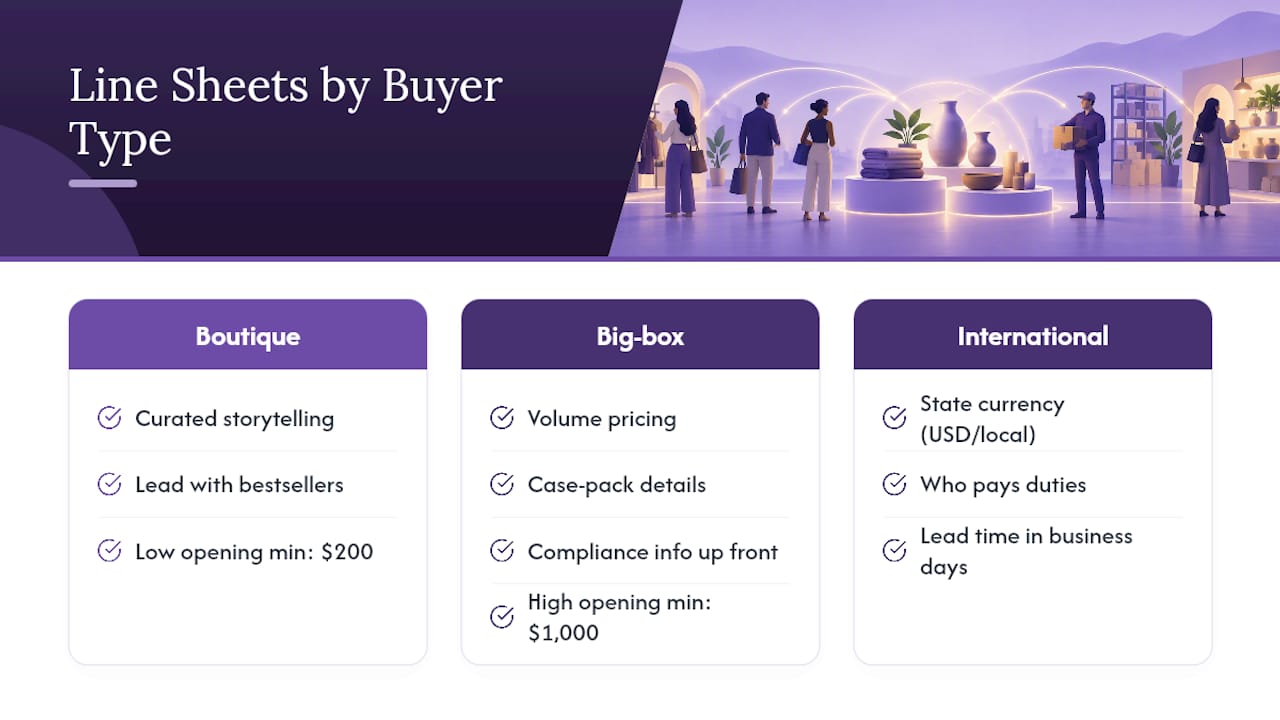
A specialty boutique buyer and a big-box merchandising team read the same line sheet completely differently. The boutique buyer wants curated storytelling in small doses and is comfortable with a lower opening minimum. The big-box buyer wants volume pricing, case pack detail, and compliance information up front, and will skip past anything that reads as precious.
Build separate sheets, or separate sections within one sheet, by buyer tier. A specialty sheet might lead with your bestsellers and a modest $200 opening minimum. A distributor-facing sheet might lead with case pack economics and a $1,000 minimum with volume breaks at 50 and 100 units.
International buyers add another layer. If you’re quoting a European retailer, note whether your wholesale price is in USD or their local currency, and be explicit about who covers duties and customs. A buyer working across time zones also benefits from having lead time stated in business days rather than a vague “a few weeks.”
Retailers in different channels weigh different things too. A grocery or specialty food buyer cares intensely about case pack and shelf life. A gift shop buyer cares about MOQ flexibility and reorder ease. If you sell into both channels, resist the temptation to force one generic sheet to serve them; split it, and each version converts better because it speaks to what that buyer actually needs to decide.
Getting Product Photos Right for Your Line Sheet
Line sheet photography has one job: let a buyer identify the product instantly and trust what they’re ordering. That’s a different brief than lifestyle photography built to sell an emotion.
Shoot each SKU on a plain, consistent background, ideally white or light gray, so buyers can scan a full page without their eye jumping between inconsistent settings. Keep lighting even across your entire catalog. A sheet where half the products look warm and half look cool reads as unfinished, even if every individual photo is technically good.

Show every color and material variant separately rather than relying on a single hero shot with a color swatch below it. Buyers ordering apparel or accessories want to see the actual product in each variant, not imagine it. For products with texture or detail that matters to a buyer’s decision, include one close-up alongside the full product shot.
Crop consistently. If one product fills the frame and the next has excess white space around it, your line sheet looks uneven even with strong individual photography. Export images at a resolution that looks sharp on screen but doesn’t bloat your file size. A gorgeous 40-megabyte PDF that won’t open on a buyer’s phone has already lost the sale.
Finally, keep photography separate from your file-naming discipline. Name each image file using the same SKU that appears on the invoice and inventory system, so there is never a mismatch between what a buyer sees and what they receive.
Keeping Your Line Sheet Current Season After Season
Your line sheet is only as good as its most recent update. Treat it as a living document tied to your product calendar, not a one-time project you finish and forget.
Set a fixed cadence tied to your business, not an arbitrary date. Seasonal brands typically regenerate their sheet at the start of each selling season, plus immediately whenever a price or availability change happens outside that cycle. A brand launching new SKUs monthly needs a lighter, faster update process than one that plans two collections a year.
Archive every prior version instead of overwriting it. If a buyer places an order referencing an old sheet, you want to be able to pull that exact version and confirm what pricing and terms they saw. Stamp each new version with an effective date so there’s never ambiguity about which sheet is current.
When you discontinue a product, remove it promptly rather than marking it “sold out” indefinitely. A line sheet cluttered with unavailable items wastes a buyer’s attention and makes your active inventory harder to find. The same discipline applies to price changes: update the number everywhere it appears, including any tiered sheets for different buyer segments, the same day the change takes effect.
Highlighting Bestsellers and Promotions on Your Line Sheet
Not every product deserves equal visual weight. Buyers scanning a line sheet for the first time often decide what to order based on what catches their eye in the first ten seconds, so your top performers need to earn a prominent spot.
Place bestsellers on the first page or in the first visible section, not buried alphabetically or by category deep in the document. A simple visual cue, a small badge or a distinct label like “Top Seller” next to the SKU, gives buyers permission to trust your data over guessing which items move.
For promotional items, be explicit about the terms rather than relying on price alone to signal a deal. State the promotional window, the standard price beside the promotional price, and any minimum quantity required to qualify. A buyer who can’t tell whether a lower number is your standard wholesale price or a limited-time offer will often just skip past it to avoid confusion.
Consider a dedicated section for new arrivals separate from your core line, especially if you’re introducing several SKUs at once. This keeps buyers who already carry your bestsellers from having to hunt through the full document to find what’s actually new this season.
Copyright, Trademarks, and Legal Basics for Line Sheets
Your line sheet is a business document circulating outside your company, which makes it worth a quick legal gut check before wide distribution. Include your registered trademark symbol next to your brand name and any protected product names the first time they appear in the document, consistent with however you use that mark elsewhere.
Product photography deserves the same care. If you commissioned a photographer, confirm your usage rights cover wholesale and marketing distribution, not just your own website, before that photography ends up in a buyer’s shared drive or a retailer’s own marketing materials.
Be cautious about what claims you print next to a product, particularly for categories like food, cosmetics, or supplements where regulatory bodies govern label language. A line sheet that overstates a certification or a health claim creates liability that has nothing to do with your actual product quality.
If your business involves licensed characters, prints, or collaborations, confirm your license terms explicitly cover wholesale distribution before that product appears on a sheet sent to retailers you don’t have a direct relationship with yet. None of this replaces legal counsel for your specific situation, but a five-minute review before your first big distribution push is worth the time.
Why the Line Sheet Still Outperforms the Pitch Deck
Most brands over-invest in the story and under-invest in the mechanics of the order itself. A buyer doesn’t need to feel your brand’s mission on page one. They need to know the price, the minimum, and how fast they can get inventory on their floor, and the sheets that win orders are the ones that answer those questions without friction. This pattern has played out across thousands of retailer introductions in multiple markets, with a consistent finding: clarity closes orders faster than polish. Brands that get buyer relationships moving quickly are almost always the ones whose documents did the selling before the phone call ever happened.
Get Buyer-Ready Line Sheets and Retailer Introductions Faster
Building the perfect line sheet solves half the problem. Finding buyers who are actually ready to open it is the other half, and that’s where most brands lose months to cold outreach and trade show costs that never quite pay off. Some agencies pair AI-driven buyer matching with hands-on relationship building to help ensure your finished line sheet gets in front of retailers who fit your category and market instead of sitting in a generic email blast.
Kingpin charges one monthly fee, set on the strategy call, and 0% commission, while brands keep full ownership of every buyer relationship. This gives brands a managed alternative to the slow grind of trade shows and traditional sales agents. If your line sheet is ready but your buyer pipeline isn’t, book a strategy call to see how Kingpin can put it in front of the right retailers.
Sources
FAQ
What Is a Line Sheet in Wholesale?
A wholesale line sheet is a buyer-facing ordering document that lists each product with its image, SKU, variants, wholesale price, MSRP, minimum order quantity, and availability. It’s built to let a retailer place an order, unlike a catalog or lookbook, which exists mainly to build brand interest.
How Do I Create a Line Sheet?
Start by gathering your master price list, product photography, SKUs, and current availability in one place. Populate a row per product with pricing and minimums, add document-level terms like payment and shipping, then validate every price against your live pricing system before distributing it.
How Do I Make a Wholesale Pricing Sheet?
Calculate true unit cost first, covering materials, labor, packaging, and fulfillment, then build your wholesale price and MSRP from that number rather than guessing at a markup. List SKU, wholesale price, MSRP, MOQ, and any quantity breaks, keeping wholesale and retail pricing visibly separate on the page.
What Is the Best Way to Find Wholesale Buyers?
There’s no single best approach. Brands typically combine trade shows, cold outreach, and buyer databases, though an AI-powered wholesale team like Kingpin can handle that search by finding the retailers that fit a brand in every market, with the reason for each one.
Should I Send a PDF or a Shoppable Digital Line Sheet?
A PDF works well for trade shows and quick email attachments, but it goes stale the moment pricing or inventory changes. A shoppable digital line sheet keeps pricing current and lets buyers tag products and build an order in place, which tends to reduce the friction that stalls orders.
A wholesale line sheet is a buyer-facing ordering document, not a marketing piece: every row needs a product image, SKU, wholesale price, minimum order quantity, and availability so a retailer can act on it immediately. The working rule is simple. If a buyer opens the file and cannot place an order without emailing you three follow-up questions, the sheet is not finished.
TL;DR:
Use a consistent SKU system across all platforms to prevent fulfillment errors and ensure smooth order processing.
Include clear, well-lit product images and detailed variant information for each SKU to enable instant recognition and accurate ordering.
Clearly differentiate between opening minimums and reorder minimums to avoid ambiguity and streamline the purchasing process.
Regularly update and archive current versions of the line sheet to maintain accuracy, especially after price changes or product discontinuations.
Consider adopting digital, shoppable line sheets to provide real-time pricing and availability, reducing order friction and outdated information risks.
KingpinReach More Relevant Retail BuyersKingpin helps consumer brands connect with global retailers, streamline wholesale sales, and keep ownership of buyer relationships.Explore Kingpin
Table of Contents
What Is a Wholesale Line Sheet, and How Is It Different From a Catalog?
Per-Product Row Fields: The SKU-Level Checklist Buyers Expect
Document-Level Fields and Ordering Terms Buyers Need
PDF or Shoppable Line Sheet? Choosing a Format
How Do You Create a Wholesale Line Sheet Step by Step?
How Should You Price Products on a Wholesale Line Sheet?
Common Mistakes That Stall a Wholesale Order
Templates, Tools, and Piloting Your Line Sheet
Tailoring a Line Sheet for Different Buyer Types
Getting Product Photos Right for Your Line Sheet
Keeping Your Line Sheet Current Season After Season
Highlighting Bestsellers and Promotions on Your Line Sheet
Copyright, Trademarks, and Legal Basics for Line Sheets
Why the Line Sheet Still Outperforms the Pitch Deck
Get Buyer-Ready Line Sheets and Retailer Introductions Faster
Sources
FAQ
What Is a Wholesale Line Sheet, and How Is It Different From a Catalog?
A wholesale line sheet exists to close a sale, not to tell your brand story. A catalog or lookbook sells a feeling. A line sheet sells a transaction, with product images tied directly to SKUs, wholesale pricing, and minimums a buyer can act on in one sitting.
Send a sell sheet or lookbook when you’re building interest before a buyer has committed to your brand. Send the line sheet once a retailer is ready to talk numbers, whether that’s after a trade show introduction or a cold outreach email. One reference calls a good line sheet the “Cliffs Notes” of your full catalog, and that framing holds: a single sentence of context per collection, then straight into orderable data.
Consistent SKU IDs matter more than most brands realize. If your invoices, order forms, and CRM all reference a product differently, you’re inviting fulfillment errors before the first case ships.
Per-Product Row Fields: The SKU-Level Checklist Buyers Expect
Every row on your line sheet needs to answer the same question a buyer’s inventory system will ask: what is this, how much does it cost, and when can I get it? Skip a field and you’ve handed the buyer a reason to set your sheet aside.
Include these on every product row:
Product thumbnail — a clean, well-lit image, not a lifestyle shot
Style name and SKU or style number — one immutable identifier, used the same way everywhere
Variant codes — size, color, or material options with their own sub-SKUs
Wholesale price — the number the buyer actually pays per unit
MSRP — shown separately so buyers can calculate their margin instantly
MOQ — the minimum quantity required per SKU or style
Case pack — how units are boxed or bundled for shipping
Availability or ship window — in stock, pre-order, or a specific date
Availability sitting right next to each SKU matters more than it seems. Buyers building seasonal floor sets need to know exactly when inventory arrives, and a general “contact us for availability” note kills momentum at the exact moment a buyer was ready to commit.
Pro Tip: Use the same SKU across your photography filenames, invoices, order forms, and inventory system. A product called “Coral Tote” in your line sheet and “Tote 04 Coral” in your fulfillment software is how orders ship wrong.
Document-Level Fields and Ordering Terms Buyers Need
Per-row data gets a buyer interested. Document-level terms are what let them actually complete the purchase. These live at the top or bottom of your sheet, and they answer the questions a buyer would otherwise have to ask over email.
Cover these terms clearly:
Brand name and logo, plus the season or collection name
Effective date, and order/cancel dates if the collection is seasonal
Opening-order minimum and reorder minimum, labeled separately
Payment terms (net 30, credit card on file, deposit required)
Shipping responsibility and estimated lead time
Return or exchange policy
Contact details and exact ordering instructions (email, order form, or shoppable link)
Labeling opening minimums and reorder minimums separately avoids a common friction point. Buyers read a dollar minimum differently than a per-SKU minimum, and an unlabeled number reads as ambiguous rather than firm.
PDF or Shoppable Line Sheet? Choosing a Format
A static PDF is portable, easy to attach to an email, and works without internet access at a trade show booth. Its weakness shows up the moment pricing or inventory changes: every buyer holding an old copy is now working from outdated numbers.
Digital and shoppable line sheets solve that problem by pulling live pricing and letting buyers tag products and build an order in place. RepSpark’s research on buyer behavior points to this as one of the single biggest upgrades a brand can make to reduce order friction.
Whichever format you choose, build in version control:
Stamp every sheet with an effective date
Archive outdated versions instead of deleting them
Regenerate and redistribute the moment price or availability changes
Keep file size manageable for email, and consider tiered sheets for different buyer segments
A polished but outdated PDF is worse than a plain, current one. Buyers forgive simple formatting. They don’t forgive a price that’s wrong.
How Do You Create a Wholesale Line Sheet Step by Step?
Building your first line sheet, or fixing one that isn’t converting, follows a repeatable sequence:
Gather your data. Pull your master price list, final product photography, SKU list, and current availability into one place before you touch layout.
Decide who this sheet is for. A specialty boutique buyer and a big-box buyer often need different collections, minimums, or even pricing tiers.
Populate per-SKU rows. Add images, variants, wholesale price, MSRP, MOQ, and case pack for every item in that collection.
Add document-level terms. Season, effective date, minimums, payment and shipping terms, contact info.
Validate every price. Check each number against your live pricing system or master list rather than trusting what you typed.
Export and optimize. Compress the PDF or publish the digital version, keeping file size reasonable.
Pilot with one buyer. Send it to a trusted contact first and ask if anything is unclear before wide distribution.
Set an update cadence. Decide now whether you’ll refresh this sheet monthly, seasonally, or on every price change.
Pro Tip: Before you send anything, open the file on your phone. If a buyer can’t read the wholesale price or MOQ at a glance on a small screen, they won’t chase down a laptop to figure it out. They’ll move to the next email in their inbox.
How Should You Price Products on a Wholesale Line Sheet?
Wholesale price starts with unit cost, not a guess. Add up materials, labor, packaging, overhead, and fulfillment per unit before you write a single price on the sheet. Skip this step and you’re pricing off intuition, which tends to erode margin the moment order volume grows.
Once you know true unit cost, build a simple worksheet: unit cost leads to wholesale price, wholesale price leads to MSRP. Publish both numbers on the line sheet, kept visibly separate, so a buyer can calculate their own margin without a calculator. If you offer quantity breaks, list the tiered unit price directly next to the standard MOQ line.
Resist the urge to apply a universal markup, like a flat 2.5x wholesale-to-retail rule, across your whole line. Pricing depends on your specific product cost, freight, the retailer’s own margin needs, and where you’re positioned against similar brands in your category. A candle that costs $4 to produce and a leather bag that costs $40 to produce don’t belong under the same markup formula, even if they sell in the same boutique. Model margin per product line instead, and adjust as your cost inputs change.
Common Mistakes That Stall a Wholesale Order
Most stalled orders trace back to a handful of preventable gaps. A buyer who hits one of these usually doesn’t email to ask. They move on.
Missing wholesale price or MOQ on any row, forcing a follow-up email
Unlabeled minimums that don’t distinguish opening orders from reorders
Inconsistent SKUs across the sheet, invoices, and your inventory system
Outdated PDF versions still circulating with old pricing or discontinued items
No clear ordering path, leaving the buyer unsure whether to reply, fill out a form, or click a link
Before you distribute anything, run a five-minute pre-send check: confirm every SKU has a price and MOQ, confirm minimums are labeled, confirm your version date is current, and confirm the ordering instructions are impossible to misread.
Templates, Tools, and Piloting Your Line Sheet
You don’t need custom software to start. Spreadsheet templates in Google Sheets or Excel work for a first version, and design tools like Canva or Adobe InDesign handle layout once you’re ready to make it look polished. Dedicated line sheet generators and shoppable platforms exist for brands ready to move past static PDFs.
Pull pricing directly from your live wholesale system rather than retyping numbers by hand
Build a separate sheet per tier if pricing varies by buyer type
Compress files before sharing, and host digital versions where a link update reaches every recipient
Test with one buyer, collect their questions, then fix the sheet before wider distribution
Consider a shoppable upgrade once you’re sending updated PDFs more than once a season. That frequency is usually the signal that a static file has become a liability rather than a convenience.
Tailoring a Line Sheet for Different Buyer Types
A specialty boutique buyer and a big-box merchandising team read the same line sheet completely differently. The boutique buyer wants curated storytelling in small doses and is comfortable with a lower opening minimum. The big-box buyer wants volume pricing, case pack detail, and compliance information up front, and will skip past anything that reads as precious.
Build separate sheets, or separate sections within one sheet, by buyer tier. A specialty sheet might lead with your bestsellers and a modest $200 opening minimum. A distributor-facing sheet might lead with case pack economics and a $1,000 minimum with volume breaks at 50 and 100 units.
International buyers add another layer. If you’re quoting a European retailer, note whether your wholesale price is in USD or their local currency, and be explicit about who covers duties and customs. A buyer working across time zones also benefits from having lead time stated in business days rather than a vague “a few weeks.”
Retailers in different channels weigh different things too. A grocery or specialty food buyer cares intensely about case pack and shelf life. A gift shop buyer cares about MOQ flexibility and reorder ease. If you sell into both channels, resist the temptation to force one generic sheet to serve them; split it, and each version converts better because it speaks to what that buyer actually needs to decide.
Getting Product Photos Right for Your Line Sheet
Line sheet photography has one job: let a buyer identify the product instantly and trust what they’re ordering. That’s a different brief than lifestyle photography built to sell an emotion.
Shoot each SKU on a plain, consistent background, ideally white or light gray, so buyers can scan a full page without their eye jumping between inconsistent settings. Keep lighting even across your entire catalog. A sheet where half the products look warm and half look cool reads as unfinished, even if every individual photo is technically good.
Show every color and material variant separately rather than relying on a single hero shot with a color swatch below it. Buyers ordering apparel or accessories want to see the actual product in each variant, not imagine it. For products with texture or detail that matters to a buyer’s decision, include one close-up alongside the full product shot.
Crop consistently. If one product fills the frame and the next has excess white space around it, your line sheet looks uneven even with strong individual photography. Export images at a resolution that looks sharp on screen but doesn’t bloat your file size. A gorgeous 40-megabyte PDF that won’t open on a buyer’s phone has already lost the sale.
Finally, keep photography separate from your file-naming discipline. Name each image file using the same SKU that appears on the invoice and inventory system, so there is never a mismatch between what a buyer sees and what they receive.
Keeping Your Line Sheet Current Season After Season
Your line sheet is only as good as its most recent update. Treat it as a living document tied to your product calendar, not a one-time project you finish and forget.
Set a fixed cadence tied to your business, not an arbitrary date. Seasonal brands typically regenerate their sheet at the start of each selling season, plus immediately whenever a price or availability change happens outside that cycle. A brand launching new SKUs monthly needs a lighter, faster update process than one that plans two collections a year.
Archive every prior version instead of overwriting it. If a buyer places an order referencing an old sheet, you want to be able to pull that exact version and confirm what pricing and terms they saw. Stamp each new version with an effective date so there’s never ambiguity about which sheet is current.
When you discontinue a product, remove it promptly rather than marking it “sold out” indefinitely. A line sheet cluttered with unavailable items wastes a buyer’s attention and makes your active inventory harder to find. The same discipline applies to price changes: update the number everywhere it appears, including any tiered sheets for different buyer segments, the same day the change takes effect.
Highlighting Bestsellers and Promotions on Your Line Sheet
Not every product deserves equal visual weight. Buyers scanning a line sheet for the first time often decide what to order based on what catches their eye in the first ten seconds, so your top performers need to earn a prominent spot.
Place bestsellers on the first page or in the first visible section, not buried alphabetically or by category deep in the document. A simple visual cue, a small badge or a distinct label like “Top Seller” next to the SKU, gives buyers permission to trust your data over guessing which items move.
For promotional items, be explicit about the terms rather than relying on price alone to signal a deal. State the promotional window, the standard price beside the promotional price, and any minimum quantity required to qualify. A buyer who can’t tell whether a lower number is your standard wholesale price or a limited-time offer will often just skip past it to avoid confusion.
Consider a dedicated section for new arrivals separate from your core line, especially if you’re introducing several SKUs at once. This keeps buyers who already carry your bestsellers from having to hunt through the full document to find what’s actually new this season.
Copyright, Trademarks, and Legal Basics for Line Sheets
Your line sheet is a business document circulating outside your company, which makes it worth a quick legal gut check before wide distribution. Include your registered trademark symbol next to your brand name and any protected product names the first time they appear in the document, consistent with however you use that mark elsewhere.
Product photography deserves the same care. If you commissioned a photographer, confirm your usage rights cover wholesale and marketing distribution, not just your own website, before that photography ends up in a buyer’s shared drive or a retailer’s own marketing materials.
Be cautious about what claims you print next to a product, particularly for categories like food, cosmetics, or supplements where regulatory bodies govern label language. A line sheet that overstates a certification or a health claim creates liability that has nothing to do with your actual product quality.
If your business involves licensed characters, prints, or collaborations, confirm your license terms explicitly cover wholesale distribution before that product appears on a sheet sent to retailers you don’t have a direct relationship with yet. None of this replaces legal counsel for your specific situation, but a five-minute review before your first big distribution push is worth the time.
Why the Line Sheet Still Outperforms the Pitch Deck
Most brands over-invest in the story and under-invest in the mechanics of the order itself. A buyer doesn’t need to feel your brand’s mission on page one. They need to know the price, the minimum, and how fast they can get inventory on their floor, and the sheets that win orders are the ones that answer those questions without friction. This pattern has played out across thousands of retailer introductions in multiple markets, with a consistent finding: clarity closes orders faster than polish. Brands that get buyer relationships moving quickly are almost always the ones whose documents did the selling before the phone call ever happened.
Get Buyer-Ready Line Sheets and Retailer Introductions Faster
Building the perfect line sheet solves half the problem. Finding buyers who are actually ready to open it is the other half, and that’s where most brands lose months to cold outreach and trade show costs that never quite pay off. Some agencies pair AI-driven buyer matching with hands-on relationship building to help ensure your finished line sheet gets in front of retailers who fit your category and market instead of sitting in a generic email blast.
Kingpin charges one monthly fee, set on the strategy call, and 0% commission, while brands keep full ownership of every buyer relationship. This gives brands a managed alternative to the slow grind of trade shows and traditional sales agents. If your line sheet is ready but your buyer pipeline isn’t, book a strategy call to see how Kingpin can put it in front of the right retailers.
Sources
FAQ
What Is a Line Sheet in Wholesale?
A wholesale line sheet is a buyer-facing ordering document that lists each product with its image, SKU, variants, wholesale price, MSRP, minimum order quantity, and availability. It’s built to let a retailer place an order, unlike a catalog or lookbook, which exists mainly to build brand interest.
How Do I Create a Line Sheet?
Start by gathering your master price list, product photography, SKUs, and current availability in one place. Populate a row per product with pricing and minimums, add document-level terms like payment and shipping, then validate every price against your live pricing system before distributing it.
How Do I Make a Wholesale Pricing Sheet?
Calculate true unit cost first, covering materials, labor, packaging, and fulfillment, then build your wholesale price and MSRP from that number rather than guessing at a markup. List SKU, wholesale price, MSRP, MOQ, and any quantity breaks, keeping wholesale and retail pricing visibly separate on the page.
What Is the Best Way to Find Wholesale Buyers?
There’s no single best approach. Brands typically combine trade shows, cold outreach, and buyer databases, though an AI-powered wholesale team like Kingpin can handle that search by finding the retailers that fit a brand in every market, with the reason for each one.
Should I Send a PDF or a Shoppable Digital Line Sheet?
A PDF works well for trade shows and quick email attachments, but it goes stale the moment pricing or inventory changes. A shoppable digital line sheet keeps pricing current and lets buyers tag products and build an order in place, which tends to reduce the friction that stalls orders.
About The Author

Ysabella Louise
Hi, I'm Ysabella, PMM at Kingpin. We believe that growing revenue shouldn't be a challenge, it should be a no-brainer. So sales teams can focus less on the struggle and more on the wins. I'm here to make sure that vision comes through in every story we tell, and to share what's working, what's changing, and what you should actually know to sell smarter.