Wholesale Pricing Strategy for Brands: Formulas, Tiers and Margins


A wholesale pricing strategy must cover production costs, protect your margin, and still leave room for your retail partners to profit and sell your product. A common starting heuristic sets retail at roughly twice cost, which puts wholesale near half of retail, though this is only a rough starting point rather than exact math. The sections below walk through the formulas, models, and governance steps that turn that heuristic into real numbers.
TL;DR:
Setting wholesale prices without including hidden costs can result in margins that are significantly lower than expected and erode profitability over time.
Tiered and volume pricing models can effectively incentivize recurring orders or large purchases, but thresholds must be based on actual order data to avoid margin erosion.
Accurate calculation of true unit cost, including freight and transaction fees, is crucial before establishing pricing tiers or discount thresholds.
Running small-scale pilots for new pricing thresholds allows for timely adjustments based on actual buyer responses before full implementation.
Tying discounts to measurable buyer actions and enforcing margin floors through automated systems helps maintain profitability amid dynamic market conditions.
KingpinPut Your Line Sheet In Front Of BuyersKingpin finds the right retailers in every market, reaches their buyers in their language and hands interested buyers to your brand. Every buyer relationship stays with you.Explore Kingpin
Table of Contents
What wholesale pricing means and the terms you need to know
Core formulas and worked examples for wholesale pricing
Volume, tiered, and stairstep pricing models explained
How to set discount tiers and thresholds without eroding profit
Matching pricing models to your business and industry
Common wholesale pricing mistakes and how to avoid them
Advanced tactics: value-based discounting and margin governance
Kingpin snapshot: retailer discovery supports pricing tests
Author perspective: priorities for executing a pricing strategy
How Kingpin connects your brand with relevant retail buyers
Sources
FAQ
What wholesale pricing means and the terms you need to know
Wholesale price is the amount a brand charges a retailer to buy product in bulk for resale. It sits between cost of goods sold (COGS) and the retail price the end customer eventually pays.
COGS covers every direct expense tied to making a unit: materials, labor, packaging, and freight into your warehouse. Gross margin is the percentage of revenue left after COGS is subtracted, while markup is the percentage added on top of cost to reach a selling price. The two sound similar but produce different numbers from the same inputs, which is why confusing them is one of the fastest ways to misprice a product.
Retailer margin is what the store keeps after buying from you at wholesale and reselling at retail. Your wholesale price has to leave enough room for that margin, or no retailer will carry your line. Margins also shift with market conditions and retailer type, a pattern confirmed by margin-price data from the U.S. Bureau of Labor Statistics, which tracks the gap between acquisition and selling price across sectors over time.
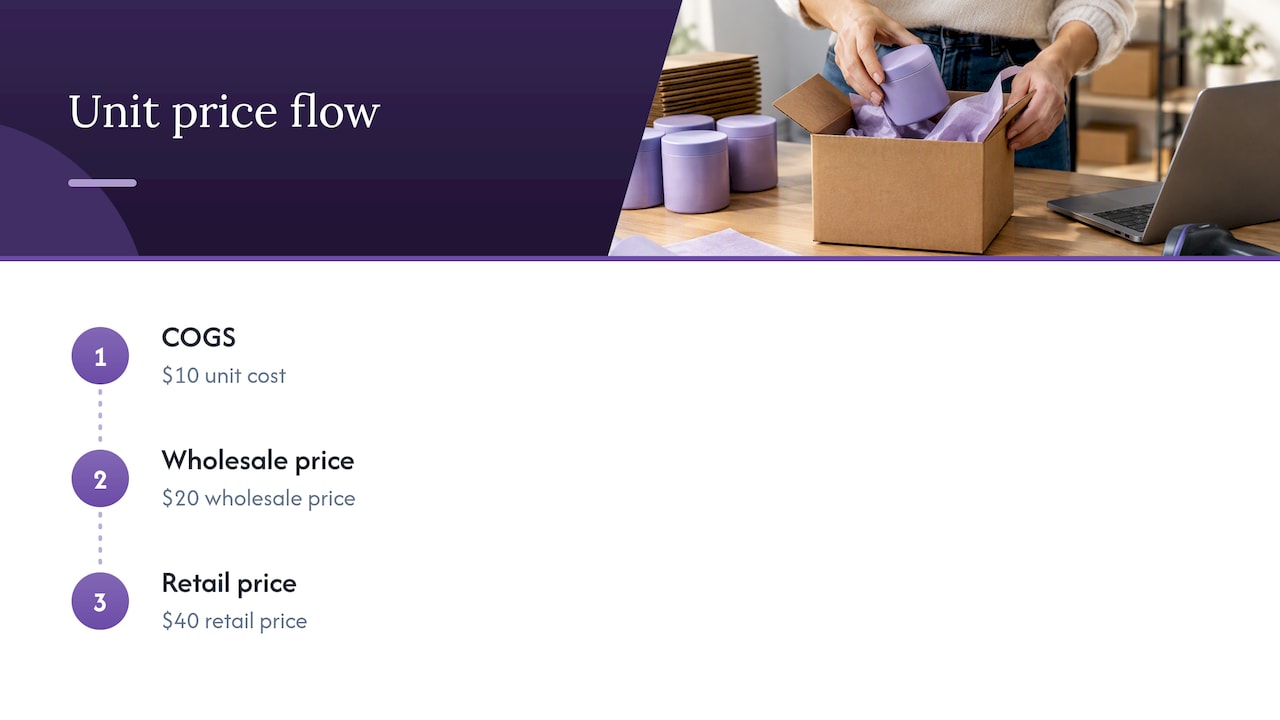
A quick flow illustrates the relationship: if a unit costs you $10 to produce, you might sell it wholesale at $20, and the retailer then prices it at $40.
Core formulas and worked examples for wholesale pricing
Three formulas cover most wholesale pricing decisions: cost-plus, keystone, and the conversion between markup and margin.
Cost-plus pricing adds a fixed percentage on top of total unit cost. If your COGS is $8 and you add 40% markup, wholesale price equals $8 x 1.40, or $11.20.
Keystone pricing doubles cost to set retail, implying wholesale lands near half of retail. QuickBooks’ wholesale pricing guide frames this as a starting heuristic rather than a guaranteed formula, since thin-margin categories and high-cost goods often break the 2x assumption.
Markup-to-margin conversion lets you move between the two measures. Margin equals (price minus cost) divided by price, while markup equals (price minus cost) divided by cost. A 40% markup on an $8 item gives you $11.20, but that same $11.20 price only reflects a 28.6% margin, not 40%, because margin is measured against price rather than cost.
A fuller example shows why hidden costs matter. Say a unit costs $8 in raw materials and labor. Add $0.50 for packaging, $0.75 for average outbound freight, and $0.25 for payment processing fees, and your true unit cost rises to $9.50. Skipping the hidden costs and working from the $8 base alone would have produced a price nearly $2 too low per unit, a gap that compounds fast across a large order. QuickBooks’ guide walks through comparable step-by-step examples for brands building these calculations for the first time.
Volume, tiered, and stairstep pricing models explained
Most wholesale pricing runs on one of three structures, each suited to a different kind of buyer behavior.
Volume pricing lowers the per-unit price as order size grows, often used to reward large one-off purchases from distributors or big-box buyers.
Tiered pricing sets a specific unit price for each quantity range, which protects margin on ongoing, recurring orders rather than single spikes.
Stairstep pricing groups orders into flat-rate bands, so a buyer pays the same total price anywhere within a range, which trades some per-unit precision for predictability.
Salesforce’s guide to volume pricing describes volume discounts as a strong lever for increasing average order value in B2B selling, provided thresholds are anchored to a real break-even floor per SKU rather than picked arbitrarily. Tiered pricing tends to suit brands with buyers who reorder steadily, since it rewards consistency more than one-time scale. Stairstep pricing fits businesses where predictable revenue matters more than squeezing the last percentage point of margin from every order, such as subscription-adjacent wholesale arrangements. Each model can coexist for different product lines, and many brands run volume pricing for new distributor relationships while using tiered pricing for existing accounts.
How to set discount tiers and thresholds without eroding profit
Setting thresholds is a process, not a guess, and skipping steps is how margin erosion creeps in unnoticed.
Calculate true per-unit cost, including materials, labor, packaging, freight, and transaction fees, so your baseline reflects reality rather than a rough estimate.
Set a minimum acceptable margin and a deepest allowable discount below which no order is approved, regardless of size.
Pull historical order data and find where most orders currently cluster, then place new thresholds just above those clusters so they actually shift buyer behavior instead of rewarding orders that would have happened anyway.
Launch the new tiers with a small group of buyers, track margin per order against your floor, and adjust before rolling the structure out across your full account base.
Salesforce’s guidance on volume pricing makes the same point about threshold placement: discounts anchored below existing order patterns fail to change behavior and simply hand away margin on business you already had.
Pro Tip: Build your margin floor into your order system as a hard rule, so no discount tier can be approved manually below the line, even by a well-meaning sales rep trying to close a deal.
Matching pricing models to your business and industry
The right model depends on how your buyers order and how your product behaves over time.
Volume pricing suits standardized, high-turn inventory businesses, distributors, and brands selling commodity-style goods where buyers place large, infrequent orders. Tiered pricing fits businesses with recurring, variable consumption, similar to how subscription platforms structure usage-based pricing, which makes it a natural match for brands with mixed SKU assortments and buyers who reorder on a cycle. Recurly’s documentation on tiered, stairstep, and volume pricing lays out the configuration differences clearly for teams setting these up in a billing or order system.
Stairstep pricing works best for capacity-based businesses or those offering predictable support alongside the product, where a buyer’s experience doesn’t change much between the low and high end of a given band. Seasonal and perishable goods need an added layer of judgment regardless of model: a model that works for a non-perishable item in Q1 may need tighter thresholds or shorter commitment windows closer to a product’s shelf-life limit or peak selling season.
Common wholesale pricing mistakes and how to avoid them
Most pricing damage comes from a short list of repeatable errors.
Halving retail price by default ignores your actual cost structure and can set wholesale below your break-even point for lower-margin goods.
Leaving out hidden costs like freight, storage, packaging, and payment processing understates your true unit cost and quietly shrinks your margin on every order.
Freezing prices after cost changes means rising input or shipping costs erode margin until a review finally catches it, often months later.
Setting discount tiers without testing thresholds against real order data rewards orders that would have happened anyway instead of changing buyer behavior.
Offering arbitrary discounts to close a deal instead of tying them to a measurable buyer behavior trains accounts to expect concessions with nothing given in return.
Revisiting prices on a set schedule, rather than only when something feels wrong, catches cost creep before it compounds across a full selling season.
Advanced tactics: value-based discounting and margin governance
Once your base pricing is solid, the next layer is rewarding the buyer behaviors that actually create value for your business.
BCG’s research on B2B discounting recommends tying discounts to measurable actions, such as standing orders, forecast sharing, or accepting exclusivity windows, rather than handing out blanket price cuts. A buyer who commits to a standing order reduces your demand uncertainty, which is worth rewarding specifically, while a buyer who simply asks for a lower price has not offered anything in return.

Rebate structures let you protect near-term margin while still incentivizing the behavior you want. Rather than cutting list price up front, BCG’s guidance suggests issuing a rebate after an order period closes if the buyer hits an agreed volume or cadence commitment. This keeps your public list price intact and reduces the merchandising friction that comes with frequent public discounting.
Operational governance ties it together: a hard margin floor in your order system, automated flags when a quote drops below that floor, and a recurring review cadence, quarterly at minimum, keep pricing decisions consistent as your product mix and cost base shift. To see how Kingpin finds retailers that fit your brand, book a strategy call: bring three shops you sell to and see the next ones that look like them.
Kingpin snapshot: retailer discovery supports pricing tests
Pricing thresholds only prove themselves once real buyers respond to them, and that feedback loop is often the slowest part of the process. Kingpin reports $700M+ in wholesale GMV since 2021 and 3,500+ retailers on Kingpin. Its research agent finds the retailers that fit a brand in every market, with the reason for each one.
The lesson for pricing specifically is about cycle time. A brand testing a new volume threshold or tiered structure needs real orders from real buyers to know whether the new numbers protect margin and move volume, and that requires getting in front of qualified retailers quickly rather than waiting months for a trade show calendar to align. Shorter buyer discovery cycles mean a brand can run a pricing pilot with one group of accounts, measure the result, and adjust before committing to a structure chain-wide.
Author perspective: priorities for executing a pricing strategy
Start by checking your COGS accuracy, since every formula above collapses if that number is wrong. Next, map the real cost of serving each retailer type, including freight and any retailer-specific fees, before you pick margin floors. Pilot new thresholds on one SKU rather than your full catalog, so a bad assumption costs you a small test instead of a quarter’s revenue.
Pricing ownership should sit with one person or a small team, reviewed quarterly, not whenever a deal feels urgent.
Pro Tip: Sequence your experiments so you test one variable at a time, cost assumptions, then thresholds, then discount structure, so you know exactly what moved the result.
How Kingpin connects your brand with relevant retail buyers
A pricing structure is only as good as the buyer response it generates, and that means getting your product in front of buyers who can actually test it. Kingpin is an AI-powered wholesale team: a research agent finds the retailers that fit your brand, and a sales coordinator agent writes to each buyer in their language with your line sheet inside. You approve which retailers to go after and keep every buyer relationship, with 0% commission.
Kingpin reports $700M+ in wholesale GMV since 2021 and 3,500+ retailers on Kingpin. For a direct next step, book a strategy call: bring three shops you sell to and see the next ones that look like them.
Sources
How to calculate wholesale price: Formulas + examples | QuickBooks
What is Volume Pricing? Benefits, Models & Tips | Salesforce
FAQ
What are the 5 C’s of pricing?
Common frameworks in pricing strategy include factors like cost, customers, competition, channels, and context, used together to set a price that covers expenses while matching what the market will bear. Different sources frame these factors differently, so treat this as a general framework rather than a fixed formula.
What are the 7 pricing strategies?
Common pricing strategies include cost-plus, keystone, value-based, competitive, penetration, skimming, and dynamic pricing, each suited to different products and markets. Wholesale brands typically rely most heavily on cost-plus and value-based approaches, layering in volume, tiered, or stairstep discount structures on top.
What is the formula for wholesale pricing?
A standard formula is wholesale price equals total unit cost divided by (1 minus target margin), which lets you set a price that guarantees your desired margin after costs. QuickBooks’ step-by-step guide walks through this calculation with worked examples, including how to fold in overhead and hidden costs before applying the formula.
What are the five main pricing strategies?
Pricing approaches often grouped as the main five include cost-plus, value-based, competitive, penetration, and skimming pricing, each prioritizing a different input, cost, perceived value, market rate, market entry speed, or early-adopter premium. Wholesale brands typically start with cost-plus to set a floor, then layer value-based discounting on top for specific buyer behaviors.
How do I avoid eroding margin with wholesale discounts?
Set a hard margin floor before offering any discount, and place discount thresholds above your existing order clusters so they change buyer behavior rather than reward orders you’d already be getting. Tying discounts to measurable actions, like standing orders or forecast sharing, as BCG’s B2B discounting research recommends, protects margin while still rewarding valuable buyers.
A wholesale pricing strategy must cover production costs, protect your margin, and still leave room for your retail partners to profit and sell your product. A common starting heuristic sets retail at roughly twice cost, which puts wholesale near half of retail, though this is only a rough starting point rather than exact math. The sections below walk through the formulas, models, and governance steps that turn that heuristic into real numbers.
TL;DR:
Setting wholesale prices without including hidden costs can result in margins that are significantly lower than expected and erode profitability over time.
Tiered and volume pricing models can effectively incentivize recurring orders or large purchases, but thresholds must be based on actual order data to avoid margin erosion.
Accurate calculation of true unit cost, including freight and transaction fees, is crucial before establishing pricing tiers or discount thresholds.
Running small-scale pilots for new pricing thresholds allows for timely adjustments based on actual buyer responses before full implementation.
Tying discounts to measurable buyer actions and enforcing margin floors through automated systems helps maintain profitability amid dynamic market conditions.
KingpinPut Your Line Sheet In Front Of BuyersKingpin finds the right retailers in every market, reaches their buyers in their language and hands interested buyers to your brand. Every buyer relationship stays with you.Explore Kingpin
Table of Contents
What wholesale pricing means and the terms you need to know
Core formulas and worked examples for wholesale pricing
Volume, tiered, and stairstep pricing models explained
How to set discount tiers and thresholds without eroding profit
Matching pricing models to your business and industry
Common wholesale pricing mistakes and how to avoid them
Advanced tactics: value-based discounting and margin governance
Kingpin snapshot: retailer discovery supports pricing tests
Author perspective: priorities for executing a pricing strategy
How Kingpin connects your brand with relevant retail buyers
Sources
FAQ
What wholesale pricing means and the terms you need to know
Wholesale price is the amount a brand charges a retailer to buy product in bulk for resale. It sits between cost of goods sold (COGS) and the retail price the end customer eventually pays.
COGS covers every direct expense tied to making a unit: materials, labor, packaging, and freight into your warehouse. Gross margin is the percentage of revenue left after COGS is subtracted, while markup is the percentage added on top of cost to reach a selling price. The two sound similar but produce different numbers from the same inputs, which is why confusing them is one of the fastest ways to misprice a product.
Retailer margin is what the store keeps after buying from you at wholesale and reselling at retail. Your wholesale price has to leave enough room for that margin, or no retailer will carry your line. Margins also shift with market conditions and retailer type, a pattern confirmed by margin-price data from the U.S. Bureau of Labor Statistics, which tracks the gap between acquisition and selling price across sectors over time.
A quick flow illustrates the relationship: if a unit costs you $10 to produce, you might sell it wholesale at $20, and the retailer then prices it at $40.
Core formulas and worked examples for wholesale pricing
Three formulas cover most wholesale pricing decisions: cost-plus, keystone, and the conversion between markup and margin.
Cost-plus pricing adds a fixed percentage on top of total unit cost. If your COGS is $8 and you add 40% markup, wholesale price equals $8 x 1.40, or $11.20.
Keystone pricing doubles cost to set retail, implying wholesale lands near half of retail. QuickBooks’ wholesale pricing guide frames this as a starting heuristic rather than a guaranteed formula, since thin-margin categories and high-cost goods often break the 2x assumption.
Markup-to-margin conversion lets you move between the two measures. Margin equals (price minus cost) divided by price, while markup equals (price minus cost) divided by cost. A 40% markup on an $8 item gives you $11.20, but that same $11.20 price only reflects a 28.6% margin, not 40%, because margin is measured against price rather than cost.
A fuller example shows why hidden costs matter. Say a unit costs $8 in raw materials and labor. Add $0.50 for packaging, $0.75 for average outbound freight, and $0.25 for payment processing fees, and your true unit cost rises to $9.50. Skipping the hidden costs and working from the $8 base alone would have produced a price nearly $2 too low per unit, a gap that compounds fast across a large order. QuickBooks’ guide walks through comparable step-by-step examples for brands building these calculations for the first time.
Volume, tiered, and stairstep pricing models explained
Most wholesale pricing runs on one of three structures, each suited to a different kind of buyer behavior.
Volume pricing lowers the per-unit price as order size grows, often used to reward large one-off purchases from distributors or big-box buyers.
Tiered pricing sets a specific unit price for each quantity range, which protects margin on ongoing, recurring orders rather than single spikes.
Stairstep pricing groups orders into flat-rate bands, so a buyer pays the same total price anywhere within a range, which trades some per-unit precision for predictability.
Salesforce’s guide to volume pricing describes volume discounts as a strong lever for increasing average order value in B2B selling, provided thresholds are anchored to a real break-even floor per SKU rather than picked arbitrarily. Tiered pricing tends to suit brands with buyers who reorder steadily, since it rewards consistency more than one-time scale. Stairstep pricing fits businesses where predictable revenue matters more than squeezing the last percentage point of margin from every order, such as subscription-adjacent wholesale arrangements. Each model can coexist for different product lines, and many brands run volume pricing for new distributor relationships while using tiered pricing for existing accounts.
How to set discount tiers and thresholds without eroding profit
Setting thresholds is a process, not a guess, and skipping steps is how margin erosion creeps in unnoticed.
Calculate true per-unit cost, including materials, labor, packaging, freight, and transaction fees, so your baseline reflects reality rather than a rough estimate.
Set a minimum acceptable margin and a deepest allowable discount below which no order is approved, regardless of size.
Pull historical order data and find where most orders currently cluster, then place new thresholds just above those clusters so they actually shift buyer behavior instead of rewarding orders that would have happened anyway.
Launch the new tiers with a small group of buyers, track margin per order against your floor, and adjust before rolling the structure out across your full account base.
Salesforce’s guidance on volume pricing makes the same point about threshold placement: discounts anchored below existing order patterns fail to change behavior and simply hand away margin on business you already had.
Pro Tip: Build your margin floor into your order system as a hard rule, so no discount tier can be approved manually below the line, even by a well-meaning sales rep trying to close a deal.
Matching pricing models to your business and industry
The right model depends on how your buyers order and how your product behaves over time.
Volume pricing suits standardized, high-turn inventory businesses, distributors, and brands selling commodity-style goods where buyers place large, infrequent orders. Tiered pricing fits businesses with recurring, variable consumption, similar to how subscription platforms structure usage-based pricing, which makes it a natural match for brands with mixed SKU assortments and buyers who reorder on a cycle. Recurly’s documentation on tiered, stairstep, and volume pricing lays out the configuration differences clearly for teams setting these up in a billing or order system.
Stairstep pricing works best for capacity-based businesses or those offering predictable support alongside the product, where a buyer’s experience doesn’t change much between the low and high end of a given band. Seasonal and perishable goods need an added layer of judgment regardless of model: a model that works for a non-perishable item in Q1 may need tighter thresholds or shorter commitment windows closer to a product’s shelf-life limit or peak selling season.
Common wholesale pricing mistakes and how to avoid them
Most pricing damage comes from a short list of repeatable errors.
Halving retail price by default ignores your actual cost structure and can set wholesale below your break-even point for lower-margin goods.
Leaving out hidden costs like freight, storage, packaging, and payment processing understates your true unit cost and quietly shrinks your margin on every order.
Freezing prices after cost changes means rising input or shipping costs erode margin until a review finally catches it, often months later.
Setting discount tiers without testing thresholds against real order data rewards orders that would have happened anyway instead of changing buyer behavior.
Offering arbitrary discounts to close a deal instead of tying them to a measurable buyer behavior trains accounts to expect concessions with nothing given in return.
Revisiting prices on a set schedule, rather than only when something feels wrong, catches cost creep before it compounds across a full selling season.
Advanced tactics: value-based discounting and margin governance
Once your base pricing is solid, the next layer is rewarding the buyer behaviors that actually create value for your business.
BCG’s research on B2B discounting recommends tying discounts to measurable actions, such as standing orders, forecast sharing, or accepting exclusivity windows, rather than handing out blanket price cuts. A buyer who commits to a standing order reduces your demand uncertainty, which is worth rewarding specifically, while a buyer who simply asks for a lower price has not offered anything in return.
Rebate structures let you protect near-term margin while still incentivizing the behavior you want. Rather than cutting list price up front, BCG’s guidance suggests issuing a rebate after an order period closes if the buyer hits an agreed volume or cadence commitment. This keeps your public list price intact and reduces the merchandising friction that comes with frequent public discounting.
Operational governance ties it together: a hard margin floor in your order system, automated flags when a quote drops below that floor, and a recurring review cadence, quarterly at minimum, keep pricing decisions consistent as your product mix and cost base shift. To see how Kingpin finds retailers that fit your brand, book a strategy call: bring three shops you sell to and see the next ones that look like them.
Kingpin snapshot: retailer discovery supports pricing tests
Pricing thresholds only prove themselves once real buyers respond to them, and that feedback loop is often the slowest part of the process. Kingpin reports $700M+ in wholesale GMV since 2021 and 3,500+ retailers on Kingpin. Its research agent finds the retailers that fit a brand in every market, with the reason for each one.
The lesson for pricing specifically is about cycle time. A brand testing a new volume threshold or tiered structure needs real orders from real buyers to know whether the new numbers protect margin and move volume, and that requires getting in front of qualified retailers quickly rather than waiting months for a trade show calendar to align. Shorter buyer discovery cycles mean a brand can run a pricing pilot with one group of accounts, measure the result, and adjust before committing to a structure chain-wide.
Author perspective: priorities for executing a pricing strategy
Start by checking your COGS accuracy, since every formula above collapses if that number is wrong. Next, map the real cost of serving each retailer type, including freight and any retailer-specific fees, before you pick margin floors. Pilot new thresholds on one SKU rather than your full catalog, so a bad assumption costs you a small test instead of a quarter’s revenue.
Pricing ownership should sit with one person or a small team, reviewed quarterly, not whenever a deal feels urgent.
Pro Tip: Sequence your experiments so you test one variable at a time, cost assumptions, then thresholds, then discount structure, so you know exactly what moved the result.
How Kingpin connects your brand with relevant retail buyers
A pricing structure is only as good as the buyer response it generates, and that means getting your product in front of buyers who can actually test it. Kingpin is an AI-powered wholesale team: a research agent finds the retailers that fit your brand, and a sales coordinator agent writes to each buyer in their language with your line sheet inside. You approve which retailers to go after and keep every buyer relationship, with 0% commission.
Kingpin reports $700M+ in wholesale GMV since 2021 and 3,500+ retailers on Kingpin. For a direct next step, book a strategy call: bring three shops you sell to and see the next ones that look like them.
Sources
How to calculate wholesale price: Formulas + examples | QuickBooks
What is Volume Pricing? Benefits, Models & Tips | Salesforce
FAQ
What are the 5 C’s of pricing?
Common frameworks in pricing strategy include factors like cost, customers, competition, channels, and context, used together to set a price that covers expenses while matching what the market will bear. Different sources frame these factors differently, so treat this as a general framework rather than a fixed formula.
What are the 7 pricing strategies?
Common pricing strategies include cost-plus, keystone, value-based, competitive, penetration, skimming, and dynamic pricing, each suited to different products and markets. Wholesale brands typically rely most heavily on cost-plus and value-based approaches, layering in volume, tiered, or stairstep discount structures on top.
What is the formula for wholesale pricing?
A standard formula is wholesale price equals total unit cost divided by (1 minus target margin), which lets you set a price that guarantees your desired margin after costs. QuickBooks’ step-by-step guide walks through this calculation with worked examples, including how to fold in overhead and hidden costs before applying the formula.
What are the five main pricing strategies?
Pricing approaches often grouped as the main five include cost-plus, value-based, competitive, penetration, and skimming pricing, each prioritizing a different input, cost, perceived value, market rate, market entry speed, or early-adopter premium. Wholesale brands typically start with cost-plus to set a floor, then layer value-based discounting on top for specific buyer behaviors.
How do I avoid eroding margin with wholesale discounts?
Set a hard margin floor before offering any discount, and place discount thresholds above your existing order clusters so they change buyer behavior rather than reward orders you’d already be getting. Tying discounts to measurable actions, like standing orders or forecast sharing, as BCG’s B2B discounting research recommends, protects margin while still rewarding valuable buyers.
About The Author

Ysabella Louise
Hi, I'm Ysabella, PMM at Kingpin. We believe that growing revenue shouldn't be a challenge, it should be a no-brainer. So sales teams can focus less on the struggle and more on the wins. I'm here to make sure that vision comes through in every story we tell, and to share what's working, what's changing, and what you should actually know to sell smarter.