FreshyWorld makes sneakers in California. Bold colourways, premium double-stitched construction, designs led by local artists. Wholesale was the next opportunity, but Rachel, FreshyWorld's Commercial Director, had stopped trusting the industry's default way of getting there.
THE CHALLENGE
"I knew trade shows weren't the answer. I just didn't have an alternative."
Rachel had run the trade-show math too many times. A booth costs between $10,000 and $20,000, around $15,000 on average. Add roughly $5,000 for flights and hotels, samples shipped across the world, the booth build, and a team pulled out of the business for three or four days.
Then there's the part nobody likes to say out loud: once you're there, the most important variable is completely out of your control. You arrive with a clear picture of the buyer you want. Then it's luck whether that buyer walks past.
Any orders you write first have to claw back a $20,000-plus investment before they do anything for the business. For Rachel, that money was better placed somewhere it was tied to a real outcome. The problem was she didn't know what that somewhere was.
And there was a second problem. FreshyWorld's ideal stockist doesn't fit a standard filter. You'd know the store the second you walked in, but you can't search for "art-forward premium sneaker boutique with a culturally-tuned buyer" in a database. You just have to know where they are, or know someone who does.
THE SOLUTION
Target exactly the doors you want. Test before you scale.
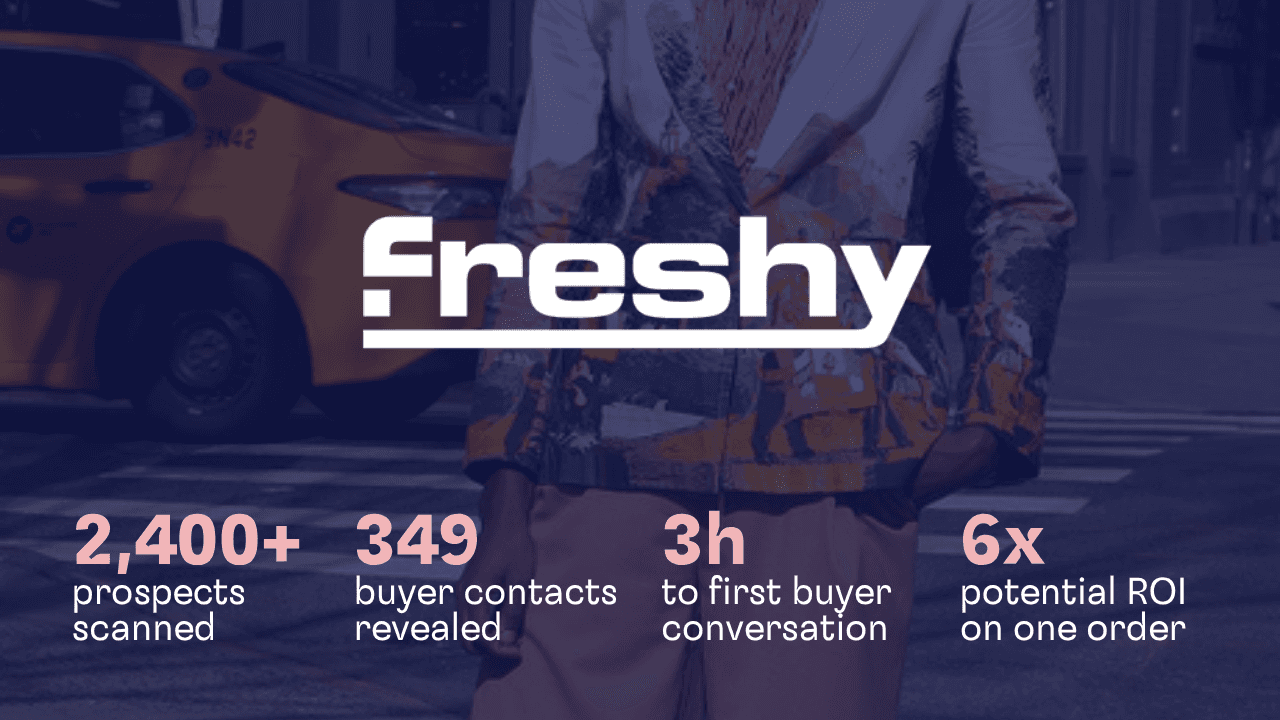
Kingpin scanned more than 2,400 potential US retailers, less than 15% of the total available market, across every profile Rachel cared about: sneaker boutiques, streetwear retailers, independent fashion stores, culturally-led concept shops.
From that pool, Kingpin saved 144 strong matches, revealed 349 verified buyer contacts, and selected roughly 100 boutiques as a focused first sample. Each message was written specifically around FreshyWorld: its California roots, premium construction, bold design language, the artist collaboration model.
Doing this manually, at this speed, in any market, isn't possible. That was the point. Instead of paying to stand still and hope, FreshyWorld chose exactly who it wanted to talk to and found out within days which retail segments would respond.
THE RESULTS
A buyer conversation in 3 hours — not 3 days on a show floor
Three replied with genuine responses, and one expressed direct buying interest, within 3 hours of the campaign going live.
The commercial math is straightforward. A genuine interested reply in this segment typically leads to an $8,000 to $10,000 opening order. That's roughly 6x the cost of the campaign from a single order if it closes. And because good wholesale accounts reorder season after season, the return compounds from there.
The campaign also produced a useful signal: Kingpin identified which retail segments were most responsive without contacting the entire US market. The next campaign can concentrate spend on the segments already showing the highest interest.
THE OUTCOME
Sales are conversations. The question is who controls them.
A trade show and an outbound campaign are buying the same thing: time in front of buyers. The difference is control.
At a show, you spend $20,000 or more up front, commit your team for days, and see who walks by. With Kingpin, Rachel chose exactly which doors to target, when to go live, and how much to spend. The first buyer conversation arrived in three hours, at a fraction of the cost.
FreshyWorld now has a channel it fully owns: scale up or down, open new markets when it wants, keep existing stockists warm while reaching new ones, with spend tied directly to revenue. That's not a campaign. That's how you build a wholesale business without handing the outcome to a show floor.
About The Author
Ysabella Louise
Hi, I'm Ysabella, PMM at Kingpin. We believe that growing revenue shouldn't be a challenge, it should be a no-brainer. So sales teams can focus less on the struggle and more on the wins. I'm here to make sure that vision comes through in every story we tell, and to share what's working, what's changing, and what you should actually know to sell smarter.