Scaling a Fashion Brand: The Operational Playbook for $2M to $20M Growth
Scaling a Fashion Brand: The Operational Playbook for $2M to $20M Growth

Key Takeaways
Fashion brand scaling rests on 5 pillars: demand forecasting, inventory management, DTC-wholesale balance, supply chain flexibility, and revenue intelligence
Growth ≠ Scale: 46% of fashion executives expect worsening conditions in 2026 — profitable scaling means building systems before you need them
Inventory is your biggest cash risk: industry benchmark is 4–6x turnover; profitable brands hit 8–12x through velocity-based allocation
Hybrid channel model wins: use wholesale for acquisition, DTC for margin and retention
A 5% increase in customer retention can increase profits by 25–95%
What You'll Learn
This playbook shows you how to scale a fashion brand from $2M to $20M without breaking your business — covering the systems, metrics, and strategies that separate profitable scaling from revenue growth that quietly destroys margins.
Table of Contents
Why Most Fashion Brands Break When Scaling
The Foundation: 3 Systems That Must Work First
The 5 Operational Pillars of Scalable Brands
Customer Retention Strategy
Strategic Partnerships
Building Community
FAQ
Why Most Fashion Brands Break When Scaling
Most fashion brands don't die from bad products. They die from good products sitting on top of broken operations.
McKinsey's State of Fashion 2026 is direct about it: the industry is grinding along at low single-digit growth, and 46% of fashion executives expect conditions to worsen this year — up from 39% the year prior. Yet some brands are scaling profitably while others implode somewhere between $5M and $10M.
The difference isn't better product or bigger marketing budgets. It's operational systems built before you desperately need them.
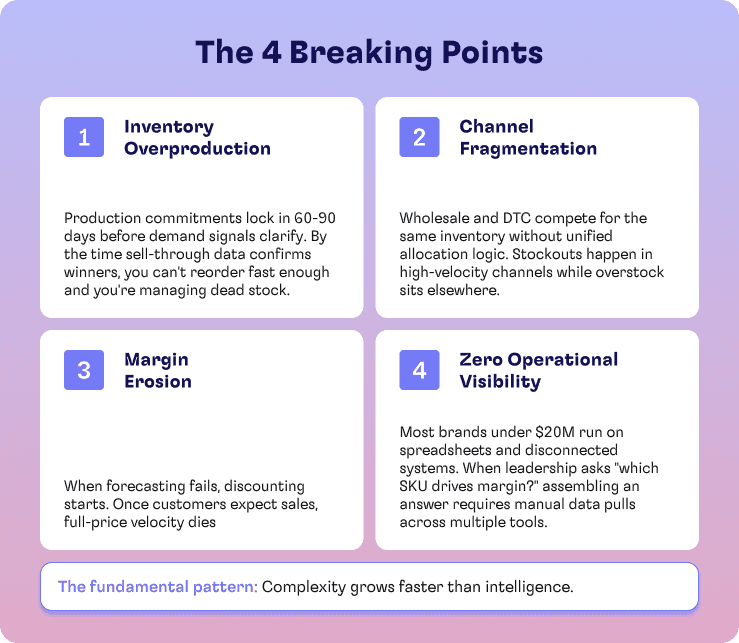
The 4 breaking points every scaling brand hits:
1. Inventory Overproduction Production commitments lock in 60–90 days before demand signals clarify. By the time sell-through data confirms your winners, you can't reorder fast enough — and you're stuck managing dead stock.
2. Channel Fragmentation Wholesale and DTC compete for the same inventory with no unified allocation logic. You stock out in your fastest-moving channel while inventory sits idle somewhere else.
3. Margin Erosion When forecasting fails, discounting starts. Once customers expect a sale, full-price velocity never recovers.
4. Zero Operational Visibility Most brands under $20M run on spreadsheets and disconnected tools. When leadership asks "which SKU is actually driving margin?" — the answer requires manual data pulls across multiple systems. That's not an analytics problem. That's a scaling problem.
The fundamental pattern is always the same: complexity grows faster than intelligence.
The Foundation: 3 Systems That Must Work First
Before advanced forecasting or channel optimization, three operational elements have to be solid.
1. Brand Identity That Drives Recognition and Retention
Brand identity isn't your logo — it's whether customers feel a consistent point of view across every touchpoint. Product descriptions, packaging, emails, customer service tone, social content. All of it.

Patagonia's "Don't Buy This Jacket" campaign prioritized sustainability over sales, strengthening customer loyalty. Everlane built on "radical transparency" — publishing factory information and cost breakdowns publicly — reducing customer acquisition costs through trust-building. When identity is clear and consistent, customers self-select. That reduces acquisition waste and improves retention economics.
2. Inventory Systems Built for Multi-Channel Scale
Spreadsheet-based inventory management breaks around $2–3M in revenue — especially when you're running multiple SKUs across wholesale and DTC simultaneously.
Working systems give you real-time tracking across all channels, automated stock updates (not overnight batch processing), sell-through velocity by SKU and region, and the ability to dynamically reallocate based on actual demand signals. This isn't optional infrastructure. It's what prevents cash flow disasters.
3. An E-Commerce Platform Architected for Growth
Platform migrations mid-growth are expensive and operationally disruptive. Build on infrastructure that scales from day one — multi-channel selling, real-time inventory sync, flexible fulfillment routing, and integrations with forecasting, analytics, and CRM tools.
Bottom line: Brand clarity, inventory visibility, and scalable commerce infrastructure. Build these before chasing growth tactics.
The 5 Operational Pillars That Enable Scale
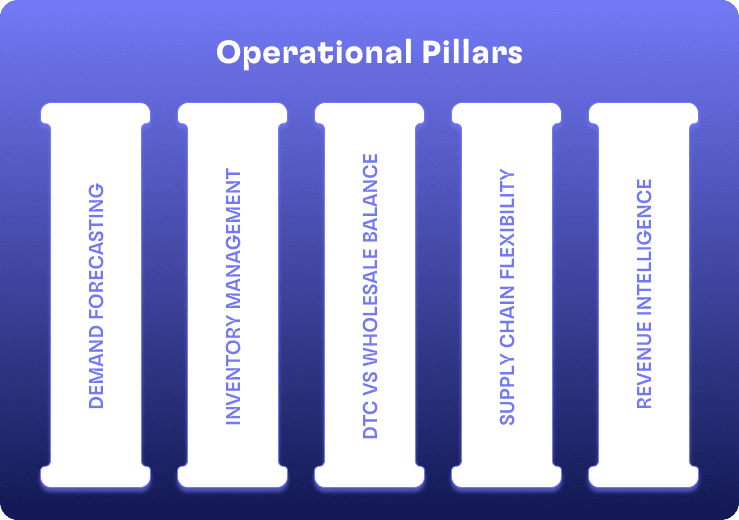
Scaling from $2M to $20M requires alignment across five operational areas. Weakness in one creates bottlenecks across the entire system.
Pillar 1: Demand Forecasting — From Historical Data to Predictive Intelligence
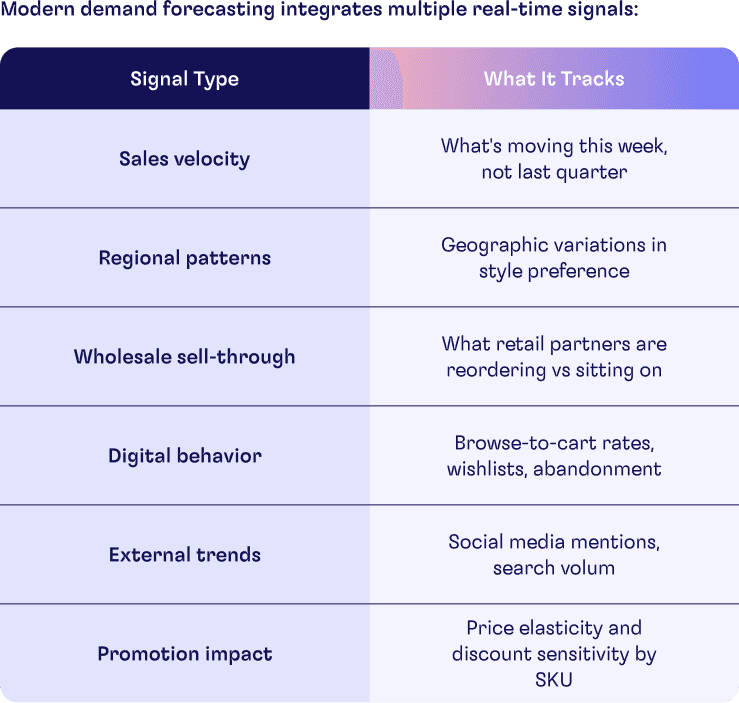
Traditional forecasting relies on last season's sales data and linear projections. That breaks when trends shift faster than your 60–90 day production cycles.
AI is accelerating this shift. McKinsey reports that more than 35% of fashion executives already use generative AI in customer service, content creation, and operations — and AI is moving from competitive edge to business necessity.
The shift: Stop forecasting based on what sold. Start predicting what will sell using real-time demand signals.
Pillar 2: Inventory Management — Where Profit Lives or Dies
Inventory is the largest cash risk in fashion. It's also where profit hides.
Two metrics that matter most:
Inventory Turnover Rate — how many times annually you sell through inventory.
Industry benchmark: 4–6x annually
Profitable scaling brands: 8–12x annually
Sell-Through Velocity by SKU — which products move in 30 days versus 120 days.
Fast movers: 30–45 days
Slow movers: 90+ days (candidates for markdown or archive)
The strategy: make inventory fluid, not static. Move product dynamically between wholesale partners, DTC fulfillment centers, international distributors, and pop-ups based on real demand signals. A SKU selling fast in California but slowly in Texas should auto-allocate more to West Coast fulfillment. That prevents regional stockouts and overstock at the same time.
Pillar 3: DTC vs. Wholesale Balance — The Model That Drives Growth
Treating DTC and wholesale as competing channels is the most common mistake brands make at scale. They serve entirely different functions.
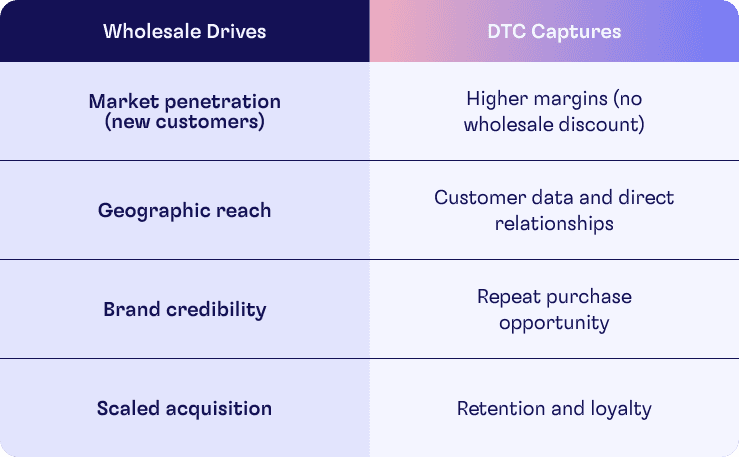
The working model: customers discover you through wholesale → first purchase → post-purchase communication moves them to your DTC channel → exclusive access and early drops → higher-margin repeat purchases through your owned channel.
Data flows both ways. Wholesale tells you which regions have demand and which retailers move product. DTC tells you which customers have high lifetime value. Use both together to drive inventory allocation and marketing spend.
Pillar 4: Supply Chain Flexibility — Speed Over Traditional Scale
The conventional wisdom is: order big, order cheap, order far ahead. That logic breaks when trends shift faster than 90-day production cycles.
Here's the paradox: true economies of scale in fashion come from velocity, not volume. Turning inventory 10x annually at slightly higher unit costs beats turning it 4x with "cheaper" production that ties up cash and forces markdowns.
Traditional | Scalable |
|---|---|
Single manufacturer | 3-5 partners for redundancy |
Offshore only | Mix of offshore + near-shore |
1,000+ units per SKU | 200-500 units to test |
90-120 day cycles | 30-45 day cycles |
The trade-off is higher per-unit cost for lower total inventory risk. For fast-moving fashion, that math almost always works.
Pillar 5: Revenue Intelligence — One System, Full Visibility
Most brands scaling from $2M to $20M can't answer basic questions in real time: Which wholesale buyers drive highest margin? Which products actually scale profitably? Where do wholesale deals stall? What's true margin by channel after all costs?
This happens because most brands operate across disconnected systems — Shopify for DTC, QuickBooks for accounting, Excel for wholesale orders, email for buyer communication. It doesn't scale past $10M.
Working revenue intelligence connects orders, pricing, buyers, products, sales pipeline, and inventory allocation into a single view:
✅ Orders (wholesale + DTC in unified view)
✅ Pricing (by channel, region, customer tier)
✅ Buyers (contact info, order history, sell-through data)
✅ Products (SKU performance, margin by channel, velocity trends)
✅ Sales pipeline (wholesale deal stage, close rates)
✅ Inventory allocation (where stock is, where it's moving)
Kingpin is built for exactly this. We connect your wholesale operations, sales, and inventory data into a single revenue system. When you ask "Should we discount this buyer?" you get an answer in 30 seconds with buyer history, inventory availability, and sell-through performance all in one view. That's the difference between fragmented tools and unified intelligence.
The shift: From fragmented tools to unified intelligence. From delayed decisions to real-time action.
Customer Retention: Where Real Growth Compounds
Acquiring a new customer costs significantly more than keeping an existing one. Yet most brands spend the majority of their budget doing exactly that.
McKinsey's State of Fashion 2026 reports that more than half of fashion executives now cite retention as a key strategic priority — a meaningful shift away from acquisition-focused growth. Harvard Business Review backs the math: a 5% increase in retention can increase profits by 25–95%.
What actually drives retention in fashion:
Product quality that matches your marketing promise. If you say "premium materials" and it feels cheap, you get one purchase and a permanently disengaged customer.
Responsive service during returns. Returns are inevitable in fashion. How you handle them determines whether customers come back.
Post-purchase engagement that adds value — not just discounts. Most brands go quiet after delivery, then surface weeks later with a coupon. A better sequence:
Day 2: Shipping confirmation with tracking
Day 7: Fit check and size guide
Day 14: Styling content, not a sales pitch
Day 30: Early access offer (exclusivity over discount)
Build the relationship before asking for the next sale.
Community and belonging. Loyalty isn't built on discounts — it's built on identity alignment. When customers feel like insiders rather than transactions, they stick through trend cycles and competitor noise.
Retention benchmarks to track weekly:
Metric | Target Benchmark |
|---|---|
Repeat purchase rate | 25-35% (industry), 50%+ (strong) |
Customer lifetime value | 3-5x customer acquisition cost |
Time to second purchase | <60 days (strong), 60-90 days (good) |
Cohort retention | Track quarterly cohorts for patterns |
Strategic Partnerships: Accelerators, Not Distractions
Scaling alone is slower and riskier. The right partnerships accelerate everything — the wrong ones just consume time.
Manufacturing relationships are your lever for speed and flexibility. Multiple partners let you run small test batches of 200–500 units to validate demand before committing, execute fast reorders on winners in 30–45 days instead of 90+, and spread seasonal production to reduce risk.
Influencer and creator collaborations work best when there's authentic alignment, a clear value exchange, and performance-based compensation where possible. Micro-influencers with highly engaged niche audiences consistently outperform macro-influencers with broad but passive followings.
Retail and distribution partners offer more than revenue. Strong wholesale relationships tell you what's selling by region, what customers are requesting, and how your products compare to competitors on the shelf. That's real market intelligence.
Partnership approach: Be surgical. Know exactly what you want — not "exposure" but access to a specific buyer or market. Define success metrics upfront. Align on commitments. Random partnerships waste time. Strategic ones compound value.
Building Community: Infrastructure, Not Marketing
Community isn't a social media strategy. It's revenue infrastructure. Brands with real communities outlast trends and outperform competitors across cycles.
Community exists when customers recommend your brand without incentive, provide feedback that shapes your next collection, create organic content featuring your products, and defend your brand when challenged.
How to build it:
Share your story and values consistently. Customers who align with your values become advocates. Customers who only like your product become price shoppers.
Create exclusive experiences — early access to drops, behind-the-scenes content, limited collaborations.
Make customers part of the brand through user-generated content, customer spotlights, and featured testimonials.
Community metrics worth tracking: Net Promoter Score, organic social mentions, referral rate, and event engagement. Community members consistently show higher lifetime value than non-community customers.
The Bottom Line: Intelligence Over Growth
Fashion brands that scale profitably from $2M to $20M don't just grow faster. They grow smarter.
They build:
Demand intelligence driven by real-time signals, not last season's numbers
Inventory control through dynamic allocation based on velocity
Channel balance with wholesale and DTC working together, not against each other
Supply chain flexibility through shorter cycles and multiple manufacturing partners
Revenue visibility with one unified system connecting buyers, products, pricing, orders, and inventory
Legacy systems create operational drag. Spreadsheets, gut decisions, and disconnected tools break somewhere between $5M and $10M. The question isn't how to grow faster — it's whether your operations can support growth without chaos.
Ask yourself:
Can you forecast demand 60–90 days out with confidence?
Do you have real-time inventory visibility across all channels?
Can you answer "which SKU drives margin?" in under 60 seconds?
Can you reallocate inventory dynamically based on velocity?
Do you have multiple manufacturing partners for flexibility?
Are wholesale and DTC working together strategically?
Are you retaining customers at a 30%+ repeat rate?
If you answered no to three or more: fix systems before pushing growth.
Key Takeaways
Fashion brand scaling rests on 5 pillars: demand forecasting, inventory management, DTC-wholesale balance, supply chain flexibility, and revenue intelligence
Growth ≠ Scale: 46% of fashion executives expect worsening conditions in 2026 — profitable scaling means building systems before you need them
Inventory is your biggest cash risk: industry benchmark is 4–6x turnover; profitable brands hit 8–12x through velocity-based allocation
Hybrid channel model wins: use wholesale for acquisition, DTC for margin and retention
A 5% increase in customer retention can increase profits by 25–95%
What You'll Learn
This playbook shows you how to scale a fashion brand from $2M to $20M without breaking your business — covering the systems, metrics, and strategies that separate profitable scaling from revenue growth that quietly destroys margins.
Table of Contents
Why Most Fashion Brands Break When Scaling
The Foundation: 3 Systems That Must Work First
The 5 Operational Pillars of Scalable Brands
Customer Retention Strategy
Strategic Partnerships
Building Community
FAQ
Why Most Fashion Brands Break When Scaling
Most fashion brands don't die from bad products. They die from good products sitting on top of broken operations.
McKinsey's State of Fashion 2026 is direct about it: the industry is grinding along at low single-digit growth, and 46% of fashion executives expect conditions to worsen this year — up from 39% the year prior. Yet some brands are scaling profitably while others implode somewhere between $5M and $10M.
The difference isn't better product or bigger marketing budgets. It's operational systems built before you desperately need them.
The 4 breaking points every scaling brand hits:
1. Inventory Overproduction Production commitments lock in 60–90 days before demand signals clarify. By the time sell-through data confirms your winners, you can't reorder fast enough — and you're stuck managing dead stock.
2. Channel Fragmentation Wholesale and DTC compete for the same inventory with no unified allocation logic. You stock out in your fastest-moving channel while inventory sits idle somewhere else.
3. Margin Erosion When forecasting fails, discounting starts. Once customers expect a sale, full-price velocity never recovers.
4. Zero Operational Visibility Most brands under $20M run on spreadsheets and disconnected tools. When leadership asks "which SKU is actually driving margin?" — the answer requires manual data pulls across multiple systems. That's not an analytics problem. That's a scaling problem.
The fundamental pattern is always the same: complexity grows faster than intelligence.
The Foundation: 3 Systems That Must Work First
Before advanced forecasting or channel optimization, three operational elements have to be solid.
1. Brand Identity That Drives Recognition and Retention
Brand identity isn't your logo — it's whether customers feel a consistent point of view across every touchpoint. Product descriptions, packaging, emails, customer service tone, social content. All of it.
Patagonia's "Don't Buy This Jacket" campaign prioritized sustainability over sales, strengthening customer loyalty. Everlane built on "radical transparency" — publishing factory information and cost breakdowns publicly — reducing customer acquisition costs through trust-building. When identity is clear and consistent, customers self-select. That reduces acquisition waste and improves retention economics.
2. Inventory Systems Built for Multi-Channel Scale
Spreadsheet-based inventory management breaks around $2–3M in revenue — especially when you're running multiple SKUs across wholesale and DTC simultaneously.
Working systems give you real-time tracking across all channels, automated stock updates (not overnight batch processing), sell-through velocity by SKU and region, and the ability to dynamically reallocate based on actual demand signals. This isn't optional infrastructure. It's what prevents cash flow disasters.
3. An E-Commerce Platform Architected for Growth
Platform migrations mid-growth are expensive and operationally disruptive. Build on infrastructure that scales from day one — multi-channel selling, real-time inventory sync, flexible fulfillment routing, and integrations with forecasting, analytics, and CRM tools.
Bottom line: Brand clarity, inventory visibility, and scalable commerce infrastructure. Build these before chasing growth tactics.
The 5 Operational Pillars That Enable Scale
Scaling from $2M to $20M requires alignment across five operational areas. Weakness in one creates bottlenecks across the entire system.
Pillar 1: Demand Forecasting — From Historical Data to Predictive Intelligence
Traditional forecasting relies on last season's sales data and linear projections. That breaks when trends shift faster than your 60–90 day production cycles.
AI is accelerating this shift. McKinsey reports that more than 35% of fashion executives already use generative AI in customer service, content creation, and operations — and AI is moving from competitive edge to business necessity.
The shift: Stop forecasting based on what sold. Start predicting what will sell using real-time demand signals.
Pillar 2: Inventory Management — Where Profit Lives or Dies
Inventory is the largest cash risk in fashion. It's also where profit hides.
Two metrics that matter most:
Inventory Turnover Rate — how many times annually you sell through inventory.
Industry benchmark: 4–6x annually
Profitable scaling brands: 8–12x annually
Sell-Through Velocity by SKU — which products move in 30 days versus 120 days.
Fast movers: 30–45 days
Slow movers: 90+ days (candidates for markdown or archive)
The strategy: make inventory fluid, not static. Move product dynamically between wholesale partners, DTC fulfillment centers, international distributors, and pop-ups based on real demand signals. A SKU selling fast in California but slowly in Texas should auto-allocate more to West Coast fulfillment. That prevents regional stockouts and overstock at the same time.
Pillar 3: DTC vs. Wholesale Balance — The Model That Drives Growth
Treating DTC and wholesale as competing channels is the most common mistake brands make at scale. They serve entirely different functions.
The working model: customers discover you through wholesale → first purchase → post-purchase communication moves them to your DTC channel → exclusive access and early drops → higher-margin repeat purchases through your owned channel.
Data flows both ways. Wholesale tells you which regions have demand and which retailers move product. DTC tells you which customers have high lifetime value. Use both together to drive inventory allocation and marketing spend.
Pillar 4: Supply Chain Flexibility — Speed Over Traditional Scale
The conventional wisdom is: order big, order cheap, order far ahead. That logic breaks when trends shift faster than 90-day production cycles.
Here's the paradox: true economies of scale in fashion come from velocity, not volume. Turning inventory 10x annually at slightly higher unit costs beats turning it 4x with "cheaper" production that ties up cash and forces markdowns.
Traditional | Scalable |
|---|---|
Single manufacturer | 3-5 partners for redundancy |
Offshore only | Mix of offshore + near-shore |
1,000+ units per SKU | 200-500 units to test |
90-120 day cycles | 30-45 day cycles |
The trade-off is higher per-unit cost for lower total inventory risk. For fast-moving fashion, that math almost always works.
Pillar 5: Revenue Intelligence — One System, Full Visibility
Most brands scaling from $2M to $20M can't answer basic questions in real time: Which wholesale buyers drive highest margin? Which products actually scale profitably? Where do wholesale deals stall? What's true margin by channel after all costs?
This happens because most brands operate across disconnected systems — Shopify for DTC, QuickBooks for accounting, Excel for wholesale orders, email for buyer communication. It doesn't scale past $10M.
Working revenue intelligence connects orders, pricing, buyers, products, sales pipeline, and inventory allocation into a single view:
✅ Orders (wholesale + DTC in unified view)
✅ Pricing (by channel, region, customer tier)
✅ Buyers (contact info, order history, sell-through data)
✅ Products (SKU performance, margin by channel, velocity trends)
✅ Sales pipeline (wholesale deal stage, close rates)
✅ Inventory allocation (where stock is, where it's moving)
Kingpin is built for exactly this. We connect your wholesale operations, sales, and inventory data into a single revenue system. When you ask "Should we discount this buyer?" you get an answer in 30 seconds with buyer history, inventory availability, and sell-through performance all in one view. That's the difference between fragmented tools and unified intelligence.
The shift: From fragmented tools to unified intelligence. From delayed decisions to real-time action.
Customer Retention: Where Real Growth Compounds
Acquiring a new customer costs significantly more than keeping an existing one. Yet most brands spend the majority of their budget doing exactly that.
McKinsey's State of Fashion 2026 reports that more than half of fashion executives now cite retention as a key strategic priority — a meaningful shift away from acquisition-focused growth. Harvard Business Review backs the math: a 5% increase in retention can increase profits by 25–95%.
What actually drives retention in fashion:
Product quality that matches your marketing promise. If you say "premium materials" and it feels cheap, you get one purchase and a permanently disengaged customer.
Responsive service during returns. Returns are inevitable in fashion. How you handle them determines whether customers come back.
Post-purchase engagement that adds value — not just discounts. Most brands go quiet after delivery, then surface weeks later with a coupon. A better sequence:
Day 2: Shipping confirmation with tracking
Day 7: Fit check and size guide
Day 14: Styling content, not a sales pitch
Day 30: Early access offer (exclusivity over discount)
Build the relationship before asking for the next sale.
Community and belonging. Loyalty isn't built on discounts — it's built on identity alignment. When customers feel like insiders rather than transactions, they stick through trend cycles and competitor noise.
Retention benchmarks to track weekly:
Metric | Target Benchmark |
|---|---|
Repeat purchase rate | 25-35% (industry), 50%+ (strong) |
Customer lifetime value | 3-5x customer acquisition cost |
Time to second purchase | <60 days (strong), 60-90 days (good) |
Cohort retention | Track quarterly cohorts for patterns |
Strategic Partnerships: Accelerators, Not Distractions
Scaling alone is slower and riskier. The right partnerships accelerate everything — the wrong ones just consume time.
Manufacturing relationships are your lever for speed and flexibility. Multiple partners let you run small test batches of 200–500 units to validate demand before committing, execute fast reorders on winners in 30–45 days instead of 90+, and spread seasonal production to reduce risk.
Influencer and creator collaborations work best when there's authentic alignment, a clear value exchange, and performance-based compensation where possible. Micro-influencers with highly engaged niche audiences consistently outperform macro-influencers with broad but passive followings.
Retail and distribution partners offer more than revenue. Strong wholesale relationships tell you what's selling by region, what customers are requesting, and how your products compare to competitors on the shelf. That's real market intelligence.
Partnership approach: Be surgical. Know exactly what you want — not "exposure" but access to a specific buyer or market. Define success metrics upfront. Align on commitments. Random partnerships waste time. Strategic ones compound value.
Building Community: Infrastructure, Not Marketing
Community isn't a social media strategy. It's revenue infrastructure. Brands with real communities outlast trends and outperform competitors across cycles.
Community exists when customers recommend your brand without incentive, provide feedback that shapes your next collection, create organic content featuring your products, and defend your brand when challenged.
How to build it:
Share your story and values consistently. Customers who align with your values become advocates. Customers who only like your product become price shoppers.
Create exclusive experiences — early access to drops, behind-the-scenes content, limited collaborations.
Make customers part of the brand through user-generated content, customer spotlights, and featured testimonials.
Community metrics worth tracking: Net Promoter Score, organic social mentions, referral rate, and event engagement. Community members consistently show higher lifetime value than non-community customers.
The Bottom Line: Intelligence Over Growth
Fashion brands that scale profitably from $2M to $20M don't just grow faster. They grow smarter.
They build:
Demand intelligence driven by real-time signals, not last season's numbers
Inventory control through dynamic allocation based on velocity
Channel balance with wholesale and DTC working together, not against each other
Supply chain flexibility through shorter cycles and multiple manufacturing partners
Revenue visibility with one unified system connecting buyers, products, pricing, orders, and inventory
Legacy systems create operational drag. Spreadsheets, gut decisions, and disconnected tools break somewhere between $5M and $10M. The question isn't how to grow faster — it's whether your operations can support growth without chaos.
Ask yourself:
Can you forecast demand 60–90 days out with confidence?
Do you have real-time inventory visibility across all channels?
Can you answer "which SKU drives margin?" in under 60 seconds?
Can you reallocate inventory dynamically based on velocity?
Do you have multiple manufacturing partners for flexibility?
Are wholesale and DTC working together strategically?
Are you retaining customers at a 30%+ repeat rate?
If you answered no to three or more: fix systems before pushing growth.
FAQ: Scaling a Fashion Brand from $2M to $20M
How long does it take to scale a fashion brand from $2M to $20M?
Typically 3-5 years if you build operations, supply chain, and distribution alongside demand growth. Brands that rush this timeline usually break under their own growth weight.
What's the biggest challenge when scaling fashion brands?
Inventory risk caused by inaccurate demand forecasting. Production locks in 60-90 days before you know what's selling. Get this wrong and you eat dead stock or miss reorders on winners.
What's the biggest challenge when scaling fashion brands?
Inventory risk caused by inaccurate demand forecasting. Production locks in 60-90 days before you know what's selling. Get this wrong and you eat dead stock or miss reorders on winners.
Can AI really help fashion brands scale?
Yes. AI is shifting from competitive edge to business necessity. According to Mckinsey, more than 35% of fashion executives already use generative AI for customer service, content creation, and operational tasks. Marketing and sales functions see the greatest productivity gains from AI automation.
How do fashion brands improve margins when scaling?
By optimizing unit economics (true cost per product including all fees), inventory turnover (reducing carrying costs), and channel mix (balancing wholesale volume with DTC margin).
When should brands expand internationally?
Only after domestic demand is consistent, supply chain can handle complexity, fulfillment and returns are efficient, and you have partners who understand local markets.
What KPIs matter most when scaling from $2M to $20M?
Sell-through rate (product velocity), inventory turnover (annual stock cycles), gross margin by channel, customer lifetime value (LTV), and repeat purchase rate.
About The Author

Ysabella Louise
Hi, I'm Ysabella, PMM at Kingpin. We believe that growing revenue shouldn't be a challenge, it should be a no-brainer. So sales teams can focus less on the struggle and more on the wins. I'm here to make sure that vision comes through in every story we tell, and to share what's working, what's changing, and what you should actually know to sell smarter.